By the time you reach 600 words, the challenge isn’t running out of space anymore; it’s actually knowing where to put it.
In the case of a 600 words essay, you’ve got enough room to build a genuinely layered argument. But not so much that you can afford to wander. And that’s exactly where students go wrong.
Once the word count crosses 500, a lot of writers start treating the essay like a mini research paper. One more example here. One more point there. And before long, the essay stops feeling like an argument and starts feeling like a list.
So, in this blog post, we’ll break down what a 600-word essay actually requires, how to divide the word count so every section earns its place, and how to go from blank page to finished draft without padding it along the way. Then, let’s get started!
What Does a 600 Words Essay Actually Require?
A 600-word essay is a mid-length analytical, argumentative, descriptive, or reflective piece built around one central thesis, developed across three distinct supporting paragraphs instead of one or two.
It sits at a length where your writing has to do something a 300 or 400 word essay never has to:
Connect multiple pieces of evidence into a single, coherent case.
But here is exactly what makes it different:
You are no longer just proving a point exists. You are showing how it holds up from more than one angle.
And whatever the essay type, the job remains the same:
- Build one argument
- Support it from three directions
and
- Close by showing how those directions connect
The extra word count compared to a 500 words essay isn’t an invitation to introduce a whole new theme; it is there so you can go one layer deeper by adding the following to a point you’ve already made, instead of just listing more points:
- A cause
- A consequence
or
- A real-world implication
Why This Word Count Gets Assigned
A 600-word cap usually shows up when an instructor wants proof that a student can withstand an argument, not just state one. This word count range is long enough that one supporting point would feel thin, but short enough that four or five points would each get shortchanged.
So, assignments at the 600 words essay length push students to:
- Develop supporting points instead of merely naming them.
- Connect separate paragraphs into one continuous argument.
- Weigh an opposing view seriously, not just mention it in passing.
And this can build the following specific habits:
- Layering evidence instead of repeating the same claim in new words.
- Managing three moving parts (three points, or two points plus a counterargument) without losing the thread.
- Writing a conclusion that synthesizes, rather than summarizes.
- Cutting material that doesn’t serve the thesis, even when it’s interesting.
- Pacing an argument so the strongest point doesn’t get buried in the middle.
Such habits transfer directly into case studies, grant proposals, longer college essays, and any professional writing where you’re building a case, not just sharing an opinion.
A 600-Word Essay Structure That Keeps Everything Proportional
Here is a sneak peek of how you should divide the word count for a 600 words essay:
| Section | Word Count | What It Does |
| Introduction | 70–80 Words | Introduces the topic, gives minimal context, ends on a thesis that signals more than one point is coming |
| Body Paragraph 1 | 100–120 Words | First supporting point, developed with an example and its consequence |
| Body Paragraph 2 | 100–120 Words | Second, distinct supporting point, developed the same way |
| Body Paragraph 3 | 90–100 Words | A counterargument, named and directly answered |
| Significance Paragraph | 80-90 Words | Explains why the argument matters beyond the immediate topic |
| Conclusion | 70–80 Words | Synthesizes the points into one closing idea, without repeating them individually |
As you may have noticed in the table above, a new paragraph has been entirely dedicated to why your argument matters. And this is something that most shorter essays skip entirely. That’s because, in a 300 or 400 word essay, there is no room for that. But at 600 words, leaving it out is what makes an essay feel technically complete but forgettable.
Writing a 600 Words Essay, Step by Step
Step 1: Read the Prompt Like You’re Being Graded on Comprehension
Before drafting anything, answer these questions:
- What exactly is it asking me to do?
- Am I building a case, comparing two things, or explaining a process?
- Does it expect me to acknowledge an opposing view?
- What would actually count as a complete answer here, not just a long one?
Most lost marks at this stage have nothing to do with bad writing; they actually come from answering a slightly different question than the one that was asked.
Step 2: Commit to Three Points, Not Four
In a 600 words essay, it is tempting to think that you have room for everything. But in reality, you don’t.
Why?
Well, you have room to properly support three points—or two points and a counterargument. And that’s the ceiling.
But let’s understand through an example!
Here is a sample prompt:
“Discuss the role mentorship plays in early career development.”
Now, a scattered response for this would say something like this:
“Mentorship helps professionals build networks, gain confidence, learn workplace norms, avoid common mistakes, access opportunities, and develop leadership skills.”
As you can see, it has made six claims, but none of them have been explored. However, a focused version for the same, above-taken prompt would narrow in. Here’s how:
“Mentorship shortens the learning curve for new professionals by giving them a source of feedback outside the formal chain of command. Instead of guessing whether a decision was reasonable, mentees can check it against someone with more experience before it becomes a costly mistake.”
Therefore, before drafting your 600 words essay further, ask yourself this question:
Can I actually support three points, with a consequence attached to each, in 600 words?
If yes, then move on.
Step 3: Outline Before You Write a Single Paragraph
A rough outline for a 600 words essay would look something like this:
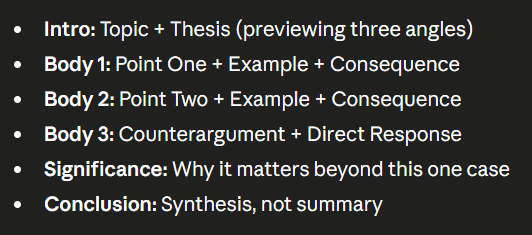
Now, this isn’t the stage for polished sentences. It is the stage where you lock in the order of ideas so you’re not deciding structure and wording at the same time.
Step 4: Open With a Thesis That Previews Depth
Your introduction needs to do three things in about 80–90 words:
- Introduce the topic.
- Add a sentence of context.
- Land on a thesis specific enough to hint that more is coming.
And here’s what that would look like in practice:

Now, this introduction doesn’t just state an opinion; it actually signals that a few connected ideas are on their way—exactly the job an introduction has at this length.
Step 5: Build Each Body Paragraph Around a Consequence, Not Just an Example
Use this formula for your first two body paragraphs:
Topic Sentence → Explanation → Example → Consequence → Link Back to the Thesis
The addition here, compared to a shorter 300 words essay, is the consequence step. For instance, instead of stopping at ‘here’s an example,’ a 600 words essay requires going one step further and explaining what that example actually leads to.
That’s the layer a 600-word essay has room for, and a 300- or 400-word one usually doesn’t. So, make sure that your second paragraph introduces a genuinely separate point, not a rephrased version of the first.
Step 6: Give the Counterargument a Paragraph That Actually Argues Back
Name the opposing view. Then respond to it with reasoning, not dismissal.
Here is a practical explanation of how you can exactly do that:

As you may have noticed, the response doesn’t pretend that the objection is weak. It acknowledges the real part and then explains why that doesn’t undermine the overall argument.
Step 7: Add a Short Paragraph on Why It Matters
This is the section that most essays under 500 words skip. And it is what separates an essay that proves a point from one that actually lands.
So, in 80-90 words, connect your argument to something bigger than the immediate example—it could be its effect on:
- Retention
- Performance
or
- Long-term outcomes
Step 8: Close by Synthesizing, Not Repeating
Your conclusion should connect the dots between your points, not restate each one in turn. So, here, you should show how the supporting points and the counterargument response fit together into a single takeaway. And then stop!
Step 9: Edit Against the Word-Count Table, Not Just for Grammar
Once your draft is done, step away for a few minutes. And when you come back, check the following:
- Does each paragraph do the one job it was assigned in the outline?
- Does the counterargument paragraph genuinely respond, rather than just acknowledge?
- Is the essay landing within roughly 540–660 words?
- Is the significance paragraph doing real work, or could it be cut without losing anything?
- Are grammar and punctuation clean throughout?
To check all of that, you can read your 600-word essay aloud, as doing so remains the fastest way to catch a paragraph that’s technically correct but doesn’t actually flow into the next one.
A Complete 600 Words Essay Example
Based on the steps discussed above, here is a sample 600 words essay that we wrote:
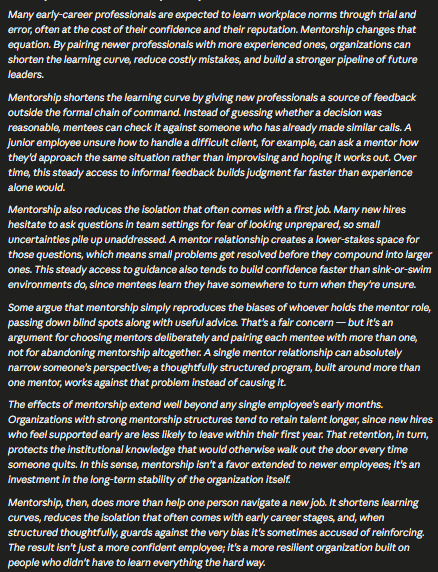
If you read this, you will notice that this sample develops two supporting points with a real consequence attached to each:
- It responds directly to a counterargument instead of just acknowledging it
- It closes by tying the argument to something larger than the original example.
So, that’s the balance a 600 words essay is graded on.
Where 600-Word Essays Usually Go Wrong
The extra room in a 600 words essay isn’t there to help you say more. It is actually there to help you prove your point more thoroughly than a shorter essay ever could. So, make sure to never fall into the trap of the following mistakes:
| The Trap | The Fix |
| Adding a fourth or fifth point because the length allows it | Cap it at three developed points, including any counterargument |
| Treating extra words as room for background history | Use them to add a consequence to each example instead |
| Naming a counterargument without responding to it | Concede its valid part, then explain why it doesn’t undo your thesis |
| Skipping the ‘why it matters’ section entirely | Include a short paragraph connecting your point to a broader outcome |
| Writing a conclusion that repeats each point in order | Synthesize the points into one connected closing idea |
| Drafting without an outline because ‘there is plenty of space’ | Outline first—more space makes drifting easier, not harder |
Answering Your Confusion About 600 Words Essays
How long does it take to write a 600 words essay?
With a topic and outline ready, most students finish in 60 to 90 minutes, including a short editing pass.
How many pages is a 600-word essay?
Roughly a page and a quarter single-spaced, or a little over two pages double-spaced, depending on font and margins.
How many paragraphs should a 600-word essay have?
Most follow six sections:
- An introduction.
- Two supporting body paragraphs.
- A counterargument paragraph.
- A short significance paragraph.
- A conclusion.
How many sentences are typically in a 600 words essay?
There is no fixed number, but most land between 30 and 35 sentences, depending on how long individual sentences run.
Is it a problem to go slightly over or under 600 words?
Not usually. Unless a strict cutoff is stated, staying within about 10% (roughly 540–660 words) is generally acceptable.
Concluding Remarks — Wrapping Up
A strong 600 word essay isn’t a 500-word essay with extra sentences tacked on. It is an essay with room to develop each point through to its consequence, answer a counterargument seriously, and explain why the whole thing matters in the first place.
So, commit to three well-chosen points, give the opposing view a real response instead of a passing nod, and close by connecting your ideas rather than repeating them.
Thus, if you get that balance right, the extra length will work for you instead of against you.

WordlyCove is a peaceful space where words, writing, and knowledge come together, an ideal platform for writers and learners.
