Quick Answer
A 400 words essay is a short academic piece—usually an introduction, two or three body paragraphs, and a conclusion—that develops one central idea within a 400-word limit. It typically runs 20–25 sentences and takes 40–70 minutes to write once you have a topic and outline ready.
A 400 words essay gives you a bit more breathing room than a 300-word one, and that’s exactly where students tend to trip up. The moment there’s extra space, it’s tempting to add one more example, one more point, or a longer intro—and before you know it, the essay feels stretched instead of sharp.
We’ve seen this pattern come up again and again with students preparing for scholarship applications, timed exams, and short-response assignments:
The essay isn’t too short on ideas; it’s just poorly distributed.
So, in this blog post, we’ll cover what a 400 words essay actually is, why it’s assigned, how to structure it properly, and how to write one without wasting the extra word count.
Then, let’s break down everything individually.
What Counts as a 400 Words Essay?
A 400-word essay is a compact piece of academic writing—argumentative, analytical, descriptive, expository, or reflective—built around a single thesis and supported within a 400-word ceiling. It sits in an odd middle zone:
It’s long enough to include a real example or two, but it’s also short enough that padding becomes obvious fast.
So, whatever the essay type, the goal of such an essay doesn’t change:
Make one argument, support it properly, and stop.
The extra 100 words compared to a 300-word essay aren’t there so you can cover more ground. They’re there so you can explain your existing point with more precision—a second example, a brief counterpoint, a tighter transition.
Why Instructors Use This Word Limit
A 400-word cap is often chosen deliberately, because it’s just long enough to test whether a student can build and support an argument, but short enough to rule out drifting. So, it rewards students who can prioritize, and it exposes students who can’t.
In fact, for this exact reason, assignments like this typically push students to:
- Pick the strongest supporting points instead of listing every possible one.
- Sequence ideas logically from one paragraph to the next.
- Practice writing under a real constraint, not an unlimited one.
The skills this activity builds help in several situations, such as:
- Avoiding repetition across paragraphs.
- Deciding what to cut when space is limited.
- Defending a thesis with actual evidence, not just assertion.
- Transitioning cleanly between supporting ideas.
- Writing efficiently under time pressure (a skill exams demand constantly).
And professionally, this same discipline shows up in status updates, project summaries, and any communication where someone reads fast and expects the point up front.
400 Word Essay Structure: A Section-by-Section Breakdown
Here is a practical word-count breakdown for a 400 word essay format that keeps every section proportionate:
| Section | Word Count | What It Does |
| Introduction | 60–70 words | States the topic, gives minimal context, ends on a clear thesis |
| Body Paragraph 1 | 85–90 words | First supporting point, explained and backed by an example |
| Body Paragraph 2 | 85–90 words | Second point, distinct from the first, still tied to the thesis |
| Body Paragraph 3 | 70–80 words | A third point, or a brief counterpoint, but often optional depending on the prompt |
| Conclusion | 50–60 words | Restates the thesis, closes with a final takeaway |
However, if your instructor only wants two body paragraphs, don’t just delete it and shorten the essay. Instead, redistribute that third paragraph’s word count between the two.
Writing a 400 Words Essay: The Process
Nail Down What the Prompt Is Actually Asking
Skimming the prompt is where most avoidable mistakes start. So, before drafting anything, answer these:
- What is the exact question or task?
- Am I meant to argue, explain, compare, or reflect?
- Is there a required essay type or citation style?
- What does ‘success’ look like for this specific prompt?
A student who fully understands the prompt but writes a mediocre sentence will usually still score better than one who writes a beautiful sentence answering the wrong question.
Commit to a Single Angle
With 400 words, it’s easy to convince yourself that you can fit two or three ideas in properly. But the reality is, you almost never can.
For instance, take the following prompt as an example:
“Discuss why time management matters for students.”
Now, a scattered response might look something like this:
“Time management helps students improve grades, handle stress, build discipline, balance responsibilities, and prepare for their careers.”
Why?
Well, simply because it has five separate claims, but none developed. And if you compare that to a focused version like one we wrote down below, you’ll feel the difference yourself:
“Time management reduces academic stress by giving students a plan instead of a scramble. When tasks are scheduled in advance, deadlines stop feeling like emergencies.”
Therefore, before moving on, check:
Can I fully support this one idea, with an example, in 400 words?
If the answer to this question is ‘yes,’ only then should you proceed.
Sketch the Essay Before Writing It
A rough outline takes two minutes and saves ten. So, for a 400 word essay outline, something like this will work perfectly:
- Intro: Topic + Thesis
- Body 1: Point One + Example
- Body 2: Point Two + Example
- Body 3: Point Three, or A Counterpoint
- Conclusion: Restated Thesis + Takeaway
Now, this phase isn’t about writing full sentences yet; it’s actually about locking in the sequence so you’re not deciding structure and wording at the same time.
Open With a Thesis-First Introduction
Your opening line should introduce the topic, add a sentence of context, and land on a clear thesis. Here is a perfect example of it:
“College students juggling coursework, jobs, and social obligations often have no real system for managing their time. Without one, deadlines start to feel like constant emergencies. Learning to manage time deliberately helps students reduce stress, stay organized, and perform better academically.”
Now, as you can see, first, we’ve built the context, then stated the thesis, in three sentences. And since there is nothing wasted here, that’s the perfect sweet spot for this phase.
Build Each Body Paragraph Around One Point
To do that, use the following reliable formula:
Topic Sentence → Explanation → Example → Tie Back to Thesis.
And based on this, here is an example that will practically showcase the implementation of this step:
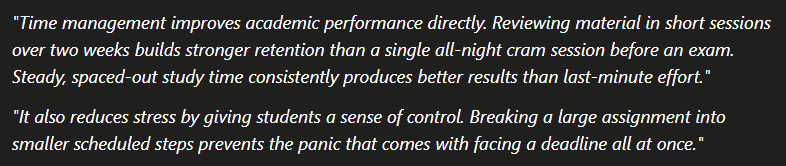
And if you’re writing a third paragraph, use it for a counterpoint. For instance, in light of the example taken above, you can address the idea that strict scheduling limits flexibility, and then you can explain why that assumption is usually wrong.
Close Without Introducing Anything New
The conclusion restates the thesis and then stops. So, it’s not the place for a fresh idea or a new example. And based on this, here is a perfect example of it:
“Time management ultimately gives students control over their workload rather than the other way around. By planning ahead and breaking tasks into steps, students can lower their stress while improving their output — a habit worth building early.”
Edit Against the Word Count, Not Just for Typos
Once the draft is done, you should step away for a few minutes before reviewing. And when you return, you should perform the editing phase, where you will check the following:
- Does this actually answer the prompt?
- Is the thesis a single, specific claim?
- Does each paragraph stick to one point?
- Is the essay within roughly 360–440 words?
- Are grammar and punctuation clean?
Now, reading the essay out loud is still one of the fastest ways to proofread and catch clunky phrasing that your eyes tend to skip over. So, don’t overlook its importance.
Full 400 Words Essay Example
Based on everything we’ve shared here, here is an example of a 400-word essay that we’ve crafted:
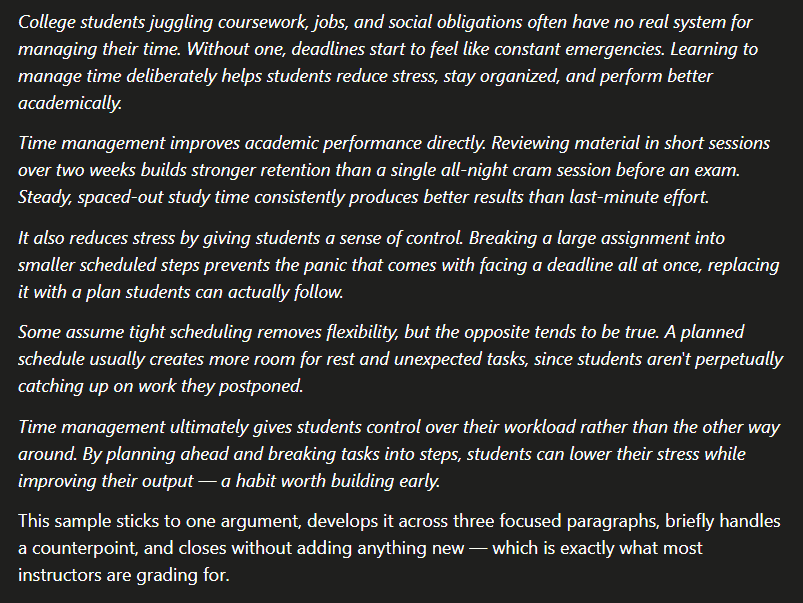
As you can see, this sample sticks to one argument, develops it across three focused paragraphs, briefly handles a counterpoint, and closes without adding anything new. And this is something around which most instructors grade the 400 words essays.
Common Mistakes in a 400-Word Essay
Sometimes, people still make mistakes even after learning a step-by-step mechanism of writing an essay or something else. So, to make sure that this never happens to you, take a look at the following table:
| Instead of This | Try This |
| Adding a fourth point just because the word count allows it | Cap it at three well-developed points |
| Using extra words for background context | Use extra words to strengthen your examples |
| Restating the same idea in different phrasing | Make sure every paragraph adds something new |
| Writing a long, wandering conclusion | Keep the close short and purposeful |
| Skipping the outline because the essay ‘isn’t that long’ | Outline first—even a rough one helps |
| Turning in the draft without checking length | Confirm the count lands near 400 words |
The point of the extra 100 words isn’t to say more; it is actually to say the same thing better.
FAQs About Writing a 400 Words Essay
How long does a 400-word essay take to write?
With a topic and outline ready, 40–70 minutes is a realistic range, including a quick editing pass.
How many pages is a 400 word essay?
Roughly one full page single-spaced, or a bit over a page double-spaced, depending on font and margins.
How many paragraphs does a 400 word essay need?
Most follow five:
- An introduction
- Three body paragraphs—though two body paragraphs work too if your prompt is narrower
- A conclusion
How many sentences should it have?
There is no strict rule, but most land around 20–25 sentences depending on sentence length.
Is going slightly over or under 400 words a problem?
Not usually. Unless a strict cutoff is stated, landing within about 10% (roughly 360–440 words) is generally fine.
Concluding Remarks — Key Takeaways
A strong 400 words essay isn’t about filling the extra space just because it’s available; it is actually about using that space to make one argument more convincing than a shorter essay could. Therefore, you should first understand the prompt, commit to a single angle, and outline before drafting. Then, build each paragraph around one point and edit against the word count rather than your gut feeling. And that’s the whole formula.

WordlyCove is a peaceful space where words, writing, and knowledge come together, an ideal platform for writers and learners.
