A 300 words essay sounds easy, until you actually start writing one. That’s because, with such a limited word count, it’s easy to go off-topic, include too much information, or struggle to fit everything into a clear introduction, body, and conclusion.
Therefore, many students find short essays more challenging than longer ones, as there is very little room for unnecessary details or repetition.
For them, we’ve created this blog post that explains exactly what a 300 words essay is, why instructors assign it, how to structure it, and how to write one step by step. So, whether you’re writing for a classroom assignment, college admission, exam, or scholarship application, this practical guide will come in handy.
Then, let’s get started!
What Is a 300 Words Essay?
A 300-word essay is a short academic paper that analyzes, argues, explains, or reflects on a single topic within a strict 300-word limit. Unlike longer essays, which allow you to explore multiple ideas in detail, this type of essay requires you to focus on one central argument and communicate it clearly using concise and well-organized writing.
Depending on your assignment, it may be of the following types:
- Argumentative
- Descriptive
- Expository
- Narrative
- Reflective
But regardless of the essay type, the objective remains the same:
Present one main idea in an easy-to-follow and logical manner.
And since every word matters here, you should avoid adding information that doesn’t directly answer the essay’s prompt.
Why Do Instructors Assign 300 Words Essays?
Well, many instructors use short academic essays like this to evaluate how effectively students communicate their ideas rather than how much they can write. For instance, a shorter word limit encourages students to:
- Think critically
- Organize their thoughts
and
- Eliminate unnecessary information
So, when assigned, such tasks help students develop essential academic writing skills, which include the following:
- Building logical arguments with relevant evidence.
- Organizing information into a structured essay.
- Preparing for timed exams and other short-form academic writing tasks.
- Staying focused on a single idea.
- Writing clearly and concisely.
And when students do learn to communicate complex ideas in fewer words, this valuable skillset extends beyond the classroom into:
- Emails
- Professional reports
- Proposals
and
- Workplace communication
A 300-Word Essay Structure
A clear structure makes your essay easier to write and helps readers follow your ideas from beginning to end. So, here is a simple structural breakdown that works well for most 300-word essays:
| Essay Section | Recommended Word Count | Purpose |
| Introduction | 50–60 words | Introduce the topic, provide brief context, and present your thesis statement. |
| Body Paragraph 1 | 70–80 words | Explain your first supporting point with a relevant example or evidence. |
| Body Paragraph 2 | 70–80 words | Present another supporting point that strengthens your thesis. |
| Conclusion | 40–50 words | Restate your thesis and summarize your main points without introducing new information. |
This structure will keep your writing balanced while ensuring each section receives enough attention.
How to Write a 300 Words Essay — A Step-by-Step Guide
Once you understand the structure, writing this type of essay becomes much more manageable. So, follow these seven steps to plan, write, and refine your essay without exceeding the word limit.
Step 1: Understand the Essay Prompt
Before you begin writing, read the assignment carefully. Why?
Well, simply because many students lose marks because they misunderstand the question, not because they lack writing skills. So, ask yourself the following questions:
- What is the main topic?
- What type of essay am I writing?
- Am I expected to explain, argue, compare, analyze, or describe?
- Are there any specific formatting or citation requirements?
And when you do, you will end up creating something like this:
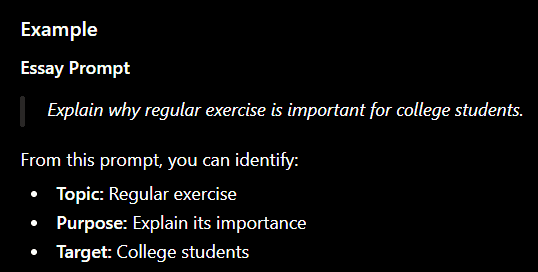
And doing so will help you stay focused and prevent you from including irrelevant information.
Step 2: Choose One Clear Main Idea
One of the biggest mistakes students make is trying to discuss too many ideas in such a short essay.
Now, remember that the available word count isn’t enough to explain multiple arguments in detail. Therefore, instead, you should focus on one central idea and develop it well.
For example, let’s say that your instruction gives you the following prompt:
“Explain why reading is important for students.”
Now, a broad response for this will look something like this:
“Reading improves vocabulary, creativity, communication skills, imagination, academic performance, confidence, and critical thinking.”
And that’s not what you want, even though all of these points are valid. That’s because if you start discussing each one, it would make the whole essay feel rushed and underdeveloped.
Therefore, instead, you should focus on one specific benefit and explain it clearly instead of mentioning several ideas without enough detail. Here’s how that would look in light of the above-provided example:
“Reading improves students’ vocabulary by exposing them to new words in different contexts. A stronger vocabulary helps students communicate more effectively and understand academic materials more easily.”
However, before moving forward in this guide, you should ask yourself the following question:
Can I fully explain this idea in 300 words?
If the answer is ‘yes,’ then you’ve chosen a suitable topic.
Step 3: Create a Simple Outline
Even a five-minute outline can make your essay easier to write. That’s because it gives you a clear roadmap and helps you avoid repeating ideas or going over the word limit.
So, here is a simple outline that you can use for almost any 300-word essay.
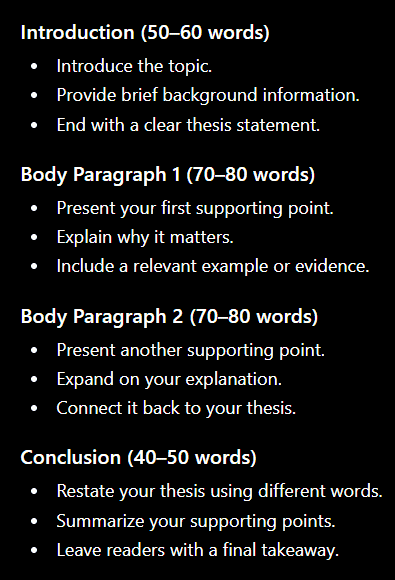
So, if you create such an outline, you will be able to plan your ideas before writing. This will make the drafting process faster and help you make sure that your essay stays focused from beginning to end.
Step 4: Write a Strong Introduction
Your introduction should quickly tell readers what your essay is about and what they’ll learn. And since you only have 300 words, you should avoid lengthy background information or overly general opening statements.
So, for such a situation, a strong introduction usually includes three elements:
- A sentence that introduces the topic.
- Brief context to help readers understand the discussion.
- A clear thesis statement that tells readers exactly what your essay will prove or explain.
Based on these 3 points, here is a practical implementation of a sample introduction:

Notice how the introduction moves directly from the topic to the thesis without unnecessary details while clearly setting the direction for the rest of the essay. Well, that should be your aim here!
Step 5: Develop Clear and Focused Body Paragraphs
The body paragraphs are where you explain and support your thesis statement. And since a 300 words essay is short, each body paragraph should focus on one supporting point instead of introducing several unrelated ideas.
So, an easy way to structure each paragraph is to follow this formula:
Topic Sentence → Explanation → Example → Link Back to the Thesis
This approach will keep your writing organized and make sure that every sentence contributes to your main argument. And based on this, here are two examples of body paragraphs:


As you can see, the second paragraph introduces a new supporting point while still reinforcing the essay’s overall argument. So, that’s what you should do! And for that, you can take help from the following suggestion:
Tip: Begin each body paragraph with a topic sentence so readers immediately understand what the paragraph will discuss.
Step 6: Write a Strong Conclusion
Your conclusion should bring the essay to a natural close. So, instead of introducing new information, you should briefly reinforce your main argument here and remind readers why it matters.
Hence, an effective conclusion usually includes the following things:
- A restated thesis.
- A summary of your supporting points.
- A final takeaway that leaves a lasting impression.
And based on these, here is a sample conclusion that we wrote:

As is obvious, our conclusion is short, meaningful, and directly connected to the rest of the essay. And that’s the perfect example of a powerful conclusion for a 300 words essay.
Step 7: Edit Your Essay and Check the Word Count
Once you’ve finished your first draft, you should spend a few minutes reviewing it before submitting. Why?
Well, editing helps:
- Eliminate unnecessary words
- Ensure your essay meets the required word count
and
- Improve clarity
So, when you’re writing within a strict word limit, removing unnecessary words is often more effective than trying to rewrite entire paragraphs. And that is why you should focus on eliminating repetition, filler phrases, and details that don’t directly support your main idea. For that, you can take assistance from the following proofreading checklist:
Does the essay answer the assignment prompt?
Is the thesis statement clear and specific?
Does each body paragraph focus on one supporting idea?
Have you removed repetitive words and unnecessary details?
Are grammar, punctuation, and spelling correct?
Is the essay close to 300 words?
Pro Tip: Read your essay aloud during proofreading. Hearing each sentence often makes it easier to identify awkward wording, repetitive phrases, or ideas that don’t flow naturally.
300 Words Essay Example
The following sample shows how all the steps come together in a well-structured essay of approximately 300 words.

If you’ve gone through the entire sample, you will have observed how the essay:
- Focuses on one central argument
- Develops it through two supporting paragraphs
and
- Stays concise without sacrificing clarity
So, that’s exactly what instructors expect from a well-written short academic essay.
Tips for Writing a Better 300-Word Essay (and Mistakes to Avoid)
Even experienced writers can struggle with short essays. So, the following tips will help you produce a stronger essay while avoiding common mistakes:
| Avoid This | Do This |
| Adding filler words or repeating the same idea. | Use clear, direct language. |
| Covering multiple ideas without explaining any of them properly. | Focus on one clear idea throughout the essay. |
| Making claims without supporting details. | Support each point with a brief example or explanation. |
| Spending too many words on background information. | Keep your introduction and conclusion concise. |
| Submitting your first draft without editing. | Leave time to proofread your work. |
| Writing immediately without planning your structure. | Create a short outline before writing. |
Remember that a successful short academic essay isn’t about fitting as many ideas as possible into the word limit; it is actually about explaining one idea clearly, logically, and effectively.
Some Frequently Asked Questions (FAQs)
Can I exceed the 300-word limit?
Unless your instructor specifies otherwise, it is best to stay as close to the required word count as possible.
How long does it take to write a 300 words essay?
If you’ve already understood the topic and gathered your ideas, writing an essay of this length usually takes 30 to 60 minutes. In fact, creating a brief outline beforehand can make the writing process much faster.
How long is a 300 words essay?
A 300-word essay is usually about one page when double-spaced or around three-quarters of a page when single-spaced, depending on the font size, spacing, and formatting requirements.
How many paragraphs should a 300 words essay have?
Most 300-word essays contain four paragraphs:
- An introduction
- Two body paragraphs
- A conclusion.
However, the exact structure may vary depending on your instructor’s guidelines or the type of essay you’re writing.
How many sentences are in a 300 words essay?
There is no fixed number of sentences, but most 300-word essays contain approximately 15 to 20 sentences.
Concluding Remarks
All in all, writing a strong 300-word essay isn’t about squeezing as much information as possible into a limited space. It’s about communicating one clear idea in a logical, organized, and concise way.
So, by understanding the assignment, planning your structure, dividing your word count, writing focused paragraphs, and proofreading your work, you will be able to produce essays that are both engaging and academically effective.

WordlyCove is a peaceful space where words, writing, and knowledge come together, an ideal platform for writers and learners.
