A 250 words essay is usually the first one students meet. But it’s also the one they underestimate the most. Why?
Well, simply because they think that ‘short’ means ‘easy,’ but that’s not the case here. And this is why:
You don’t get room to explain an idea from three angles or ease into your point. You get one shot, one paragraph, and almost no space to recover if you drift off-topic.
That’s why this length trips people up more than a 400 or 500 word essay does. But don’t you worry because in this blog post, we’ll walk you through the exact procedure of writing a 250 word essay.
From sharing what this word count limit demands to the procedure of drafting a 250 words essay that doesn’t run short or spill over, we’ll cover everything here.
So, let’s get started!
Where a 250 Word Essay Sits
A 250 words essay is the shortest form of academic writing most students are formally assigned. It runs roughly 15 to 18 sentences and asks you to prove one narrow idea using a single developed paragraph, not several.
In fact, here’s exactly what makes it different from a 300 word essay:
At 300 words, there’s just enough space to split your explanation into two short body paragraphs. But at 250, that split usually backfires—each paragraph ends up too thin to prove anything. So, instead of dividing your point, you commit to it fully, in one place.
And whether the essay prompt calls for an argumentative, descriptive, expository, or reflective response, the task doesn’t change; it remains the same:
Pick one idea. Prove it. Stop.
Why Schools Keep Assigning This Length
This word count shows up constantly in scholarship applications, timed responses, and early coursework. And that’s not random.
That’s because, at 250 words, an instructor isn’t measuring how much you know; they’re checking whether you can make a specific point without stalling, circling back, or padding to hit a minimum length.
So, this length pushes students to:
- Commit to a single point instead of hedging across several.
- Cut any sentence that doesn’t directly support the thesis.
- Move from claim to proof without a slow wind-up.
And that same instinct pays off well past school, too. For instance, a cover letter, an incident report, even a text asking your professor for a deadline extension—all of them reward the same skill as a 250 words essay, which has been beautifully summed up:
Making the point land before the reader loses interest.
The Structure of a 250 Words Essay
| Section | Word Count | What It Does |
| Introduction | 35–40 Words | Names the topic and lands directly on a specific thesis |
| Body Paragraph | 150–165 Words | Develops one point fully—explanation, evidence, and why it matters |
| Conclusion | 35–45 Words | Restates the point in different words and closes on its impact |
As you may have noticed from this table, there’s only one body paragraph, not two or three. And that’s deliberate because at this length, a second paragraph almost always means splitting your evidence in half instead of developing it properly—and half-proven beats fully-proven every time it’s compared.
Writing a 250 Words Essay, Step by Step
Step 1: Find the One Question Buried in the Prompt
Longer prompts often bury more than one question inside them. And at the 250-word length, you don’t have space to answer all of them. So, before writing anything, ask the following questions:
- What is this prompt actually asking me to prove?
- Is there a smaller, more specific question hiding inside the broad one?
- What can I safely leave out and still answer it completely?
If you can’t answer the first question in one sentence, then you’re not ready to draft yet.
Step 2: Choose One Idea and Refuse to Add a Second
This step matters more here than at any other essay length. Why?
Well, let’s understand this through an example.
Consider this prompt:
“Explain why keeping a daily journal benefits students.”
Now, a weak response would try to cover everything like this:
“Journaling improves memory, reduces stress, builds vocabulary, encourages reflection, boosts creativity, and helps with time management.”
As you can see, six claims have been made, but with zero development.
However, a focused version would pick one and actually explain it. Here’s how:
“Journaling helps students process their day by turning scattered thoughts into words, which lowers stress before it has a chance to build up.”
So, to build such a focused response, use a simple test:
Try explaining your idea out loud in two sentences. If you need a third to introduce a new point, the idea is still too big for a 250 words essay.
Step 3: Replace the Outline With a One-Line Plan
A full outline is overkill here because it can take longer to write than the essay itself. So, what you should do is lock in one line. Here’s how:
Topic: Daily journaling → Thesis: It lowers stress and strengthens memory → Proof: Active recall + emotional processing → Close: A small habit with a large payoff
Now, that’s enough to keep you from drifting once you start writing full sentences.
Step 4: Compress the Introduction Into Two Sentences
There is no room for background information. So, name the topic, land the thesis, and that’s it.
The following example will better guide you:

As you can see, we’ve written two sentences with no throat-clearing. And this sort of specific thesis is enough to tell the reader exactly where their essay is headed.
Step 5: Write the Body as One Uninterrupted Argument
With only one paragraph to work with, build it in this order:
Claim → Explanation → Evidence → Why the Evidence Actually Proves the Claim
That last piece is the one people skip—and it’s the most common reason a 250 words essay feels thin, even at the right length. That’s because naming an example isn’t the same as explaining what it proves.
Step 6: Close in One Sentence, Not a Paragraph
At this length, the conclusion is a single sentence. It restates the point in new words and lands on why it matters— nothing more.
Take a look at the following example to understand this point better:
“A habit this small shouldn’t be this effective, but that’s exactly why teachers keep recommending it year after year.”
Step 7: Edit by Cutting, Not Rewording
Your editing pass at this length is mostly subtraction. So, perform a check for the following things:
- Does every sentence in the body support the exact same claim?
- Is the introduction under 40 words?
- Does the conclusion avoid adding anything new?
- Does the full draft sit close to 250 words, give or take about 20?
If a sentence sounds nice but doesn’t move the argument forward, it doesn’t belong. In such a situation, cut that first. And add only if something essential is genuinely missing.
A Complete 250 Words Essay Example
Using the seven steps we’ve described above, here is an actual example for a 250 word essay:
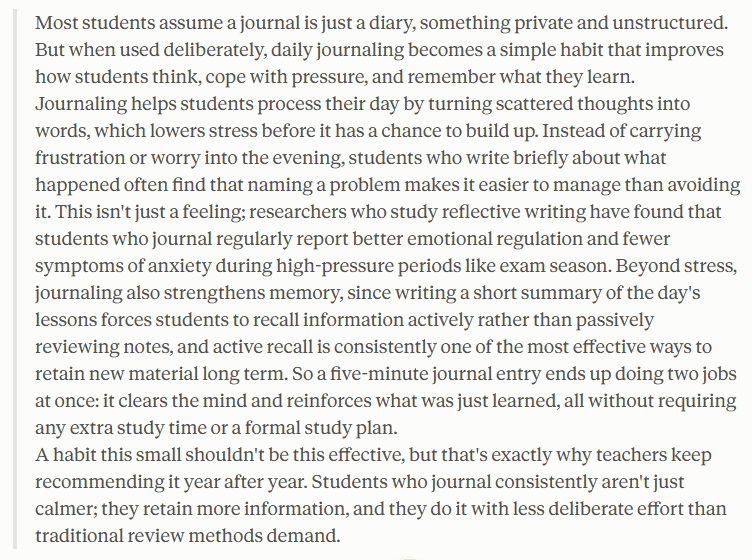
As you can see, we’ve made one claim with two connected reasons and one closing line. And that’s the whole target at this length.
Where 250 Word Essays Usually Go Wrong
Even experienced writers can struggle with short essays. So, the following tips will help you craft a stronger 250 words essay while avoiding common mistakes:
| What Goes Wrong | What to Do Instead |
| Building a full outline like it’s a longer essay | Use a one-line plan instead |
| Naming an example without explaining what it proves | Add one sentence tying the evidence back to the claim |
| Spending 60+ words on background before the thesis | Land the thesis by the second sentence |
| Splitting the argument into two thin paragraphs | Keep it as one fully developed paragraph |
| Writing a conclusion that repeats the intro word for word | Restate the point using genuinely different phrasing |
None of this is about fitting more in. It’s about not leaving anything out that the argument actually needed.
Quick Questions About 250 Words Essays
How many paragraphs is a 250 word essay?
Three: a short introduction, one body paragraph, and a one-to-two sentence conclusion.
How many sentences are in a 250 words essay?
Around 15 to 18, depending on how you write your sentences.
Is 25 minutes enough time to write one?
With a one-line plan ready beforehand, most students can draft and edit a 250-word essay in 25 to 40 minutes.
Now, Where Does This Leave You? — Concluding Remarks
A 250 words essay isn’t just a shrunken version of a longer one—it runs on a completely different rule:
Prove one thing well, and don’t reach for a second point just because there might be room for it.
So, pick your claim before you draft, build the body as a single unbroken argument, and let your edit pass be about cutting, not adding.
If you get that right, then 250 words would stop feeling like a constraint and start feeling like exactly enough.

WordlyCove is a peaceful space where words, writing, and knowledge come together, an ideal platform for writers and learners.
