
Quick Answer
A 900 words essay answers two objections across nine sections that have been built around four supporting points. Writing one usually takes 100 minutes to two and a half hours.
An 800 word essay wins by disproving the obvious counterargument. However, a 900 words essay has to handle a second counterargument:
The quiet doubt that creeps into a reader’s mind right after they’ve agreed with your main point.
But this guide will break down how to handle that extra layer.
To be precise, it will discuss the structure, the word count split, the step-by-step method, and a full sample to make everything easier to understand. So, without further ado, let’s get started!
What a 900 Words Essay Is Actually Built to Do
A 900 word essay is a fully developed argumentative, analytical, or reflective piece. It consists of:
- One thesis
- Four supporting points
and
- Two separate objections answered
That second objection is what changes here, at this length.
For instance, at 800 words, one properly argued counterpoint proves that you’ve thought past your own side. But in a 900 words essay, a second objection becomes fair game, because there is finally room to answer it without rushing the first one or running out of space.
However, the core job stays the same:
- Make one claim.
- Support it from four distinct angles.
- Take the two strongest objections seriously, not just the loudest one.
- End on what the argument adds up to, not a list of what it said.
Why This Word Count Gets Assigned
A 900-word cap usually appears when an instructor wants proof that a student can hold their ground under multiple kinds of pressure, not just restate an opinion in four different ways.
To be more precise, at this length, you’re being tested on whether you can:
- Carry four points without any one thinning into a single sentence.
- Tell which objections genuinely threaten your thesis, and which don’t.
- Handle two separate counterpoints without either one becoming a throwaway line.
- Close by connecting the argument, not by repeating the intro in slower words.
The habits that you gain from here will also help you later in grant applications, opinion writing, policy memos, and anywhere someone might push back from two directions, and you need an answer ready for both.
A 900 Words Essay Structure That Keeps Every Section Earning Its Place
Here’s how the word count should split across a 900-word essay:
| Section | Word Count | What It Does |
| Introduction | 80–90 Words | States the topic and lands on a thesis that signals four points are coming |
| Score Paragraph | 70–80 Words | Defines what the claim covers, and just as importantly, what it doesn’t |
| Body Paragraph 1 | 110–120 Words | First point, fully explained with an example |
| Body Paragraph 2 | 110–120 Words | Second point, distinct from the first |
| Body Paragraph 3 | 100–110 Words | Third point |
| Body Paragraph 4 | 90-100 Words | Fourth point, often the practical or numbers-based one |
| Major Objection | 90-100 Words | The strongest pushback, conceded honestly, then answered |
| Minor Objection | 60–70 Words | A second, narrower pushback, handled fast but seriously |
| Conclusion | 70–80 Words | Pulls all four points and both answered objections into one closing idea |
As you may have noticed, there is no separate synthesis paragraph here, unlike an 800-word essay. Why?
Well, simply because, in a 900 words essay, that connecting work happens inside the conclusion itself, as answering a second objection already forces the essay to look at the thesis from more than one side before it closes.
A 900 Word Essay Structure That Keeps Every Section Earning Its Place
Step 1: Find What the Prompt Is Quietly Ruling Out
Before writing anything, work through these:
- What am I actually being asked to argue, not just discuss?
- Is there an assumption inside the question I need to address head-on?
- What separates a complete answer here from a merely long one?
- Are there two distinct kinds of pushback this argument is likely to face?
But why?
Well, simply due to the fact that most weak drafts at this length aren’t badly written; they just never figured out what the question was excluding.
Step 2: Lock In Four Points That Can Take a Hit
Four is the ceiling, same as at 800 words. But here, you’re not just picking four points; you’re picking four that can hold up once two objections come at them later.
Take this prompt for instance:
“Discuss whether the four-day work week improves organizational productivity.”
Now, a scattered answer for it would try to say everything at once.
Here’s how:
“The four-day work week boosts morale, reduces burnout, saves companies money, improves focus, helps with recruitment, and cuts down on sick days.”
But a focused version narrows it down and actually develops one:
“Employees on four-day schedules tend to complete the same output in fewer hours, because the shorter week forces them to cut low-value meetings and constant task-switching. The result isn’t less work getting done; it’s less time wasted getting there.”
So, before moving on, test each of your four points this way:
If a real objection landed on it tomorrow, would the point survive, or would it fold?
Keep the ones that survive and cut or merge the rest now, not after the draft is finished.
Step 3: Sequence the Essay Before Writing a Single Sentence
A working outline for a 900 words essay should lock in this order:
Intro → Scope → Four Points → Major Objection → Minor Objection → Conclusion
This is a sequencing step only. So, don’t write full sentences yet, just decide what comes where.
Step 4: Open With a Thesis, Then Draw the Line Around Your Claim
Your introduction needs to land a specific thesis in 80-90 words. Right after it, the scope paragraph should state exactly what your claim covers, and what it deliberately leaves out.
For the above-specified four-day work week prompt, that might mean clarifying that the claim applies to knowledge work with measurable output, not to jobs built around fixed staffing coverage, like healthcare or manufacturing.
But if you skip this step, a strong argument can get knocked down by an objection it was never actually making a claim about.
Step 5: Build Each Point Past the Example and Into Why It Holds
When it comes to a 900 words essay, you should use this shape for all four body paragraphs:
Claim → Reasoning → Real Example → Why That Example Actually Proves the Claim → Return to the Thesis
That fourth piece, explaining why the example proves the point instead of just describing it, is what keeps four paragraphs from reading like the same idea said four times.
Step 6: Concede Before You Answer the Major Objection
Name the strongest counterargument your thesis faces. Acknowledge the part that’s fair. Then explain why the thesis still holds.
For the above-specified prompt, that objection might be something like this:
“Critics argue compressing the workweek just shifts the same workload into fewer days, raising daily stress instead of lowering it.”
A weak response waves this away. But a stronger one acknowledges the real risk, then answers it:
Compression backfires without deliberate workload redesign, which is exactly why the companies seeing gains are the ones that cut meeting volume alongside the schedule change, not the ones that only shortened the calendar.
Step 7: Answer the Second Objection Fast, But For Real
The second objection in a 900 words essay doesn’t need the concede-then-answer treatment.
One tight paragraph, naming it and answering it directly, is enough.
For the above-specified topic, the implementation of this step would look something like this:
“Some argue the model only works for companies with resources to test it. That’s often true early on, but it’s true of most workplace changes, and it’s a reason to roll the model out in stages, not a reason to rule it out.”
Step 8: Close by Connecting the Argument, Not Listing It Again
Your conclusion needs to do two jobs at once here:
- Tie the four points together,
- Show how both answered objections actually strengthen the case rather than just surviving it.
Step 9: Check the Draft Against the Plan
Once the draft of your 900 words essay exists, go back through it and confirm the following:
- Does the scope paragraph actually limit the claim, or does it just repeat the introduction?
- Is the major objection conceded before it’s answered?
- Does the minor objection get a real response, not just a mention?
- Does the total land somewhere around 850–950 words?
- Does the conclusion connect the argument, or summarize it again?
Also, don’t forget to read the whole thing out loud once because it is still the fastest way to catch a paragraph that reads fine alone but doesn’t follow from the one before it.
A Complete 900 Word Essay Example
Here is a full sample of a 900 words essay, built from the exact prompt and structure above:
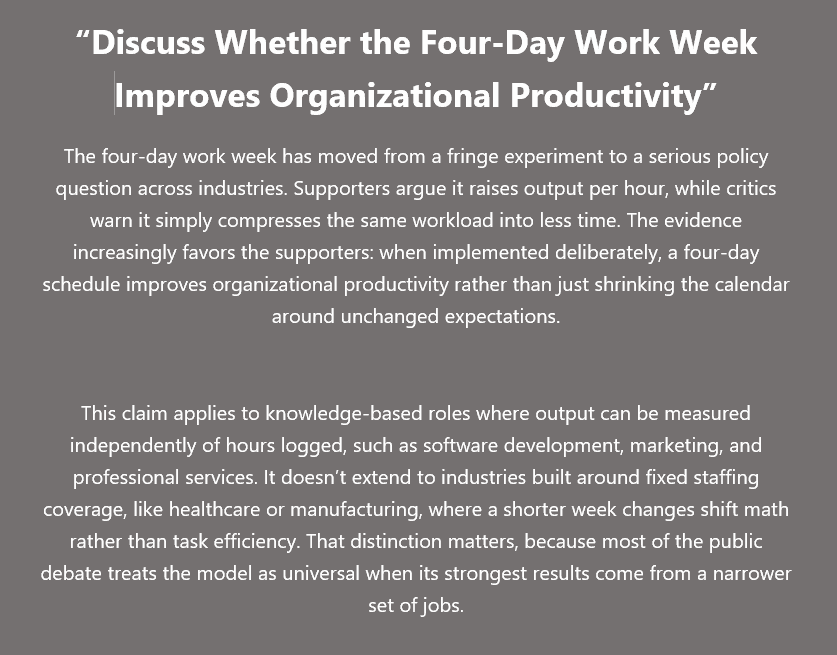
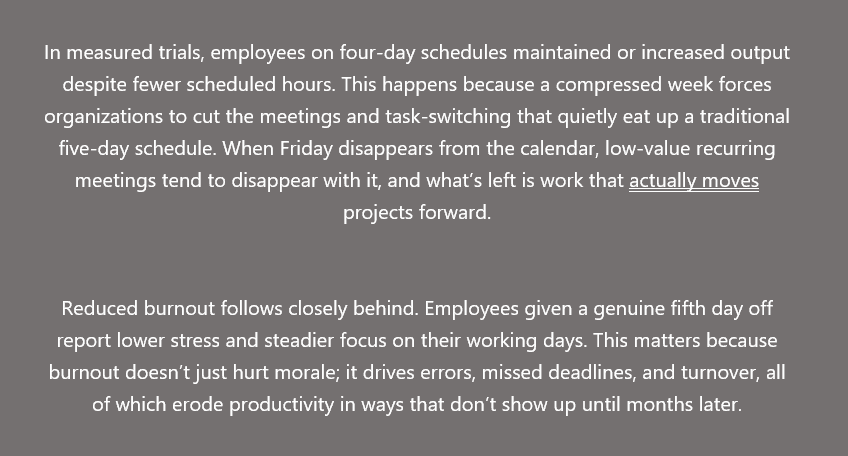
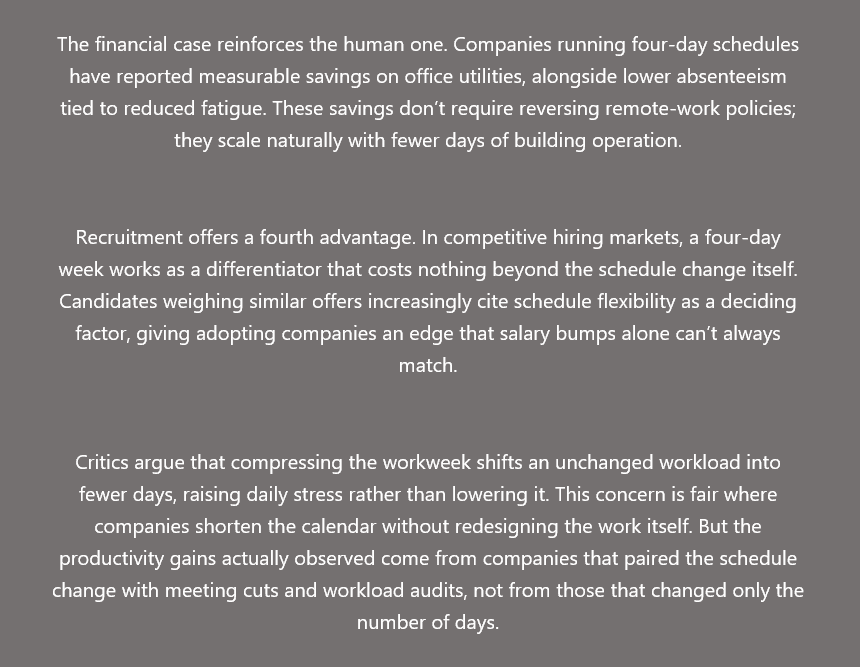
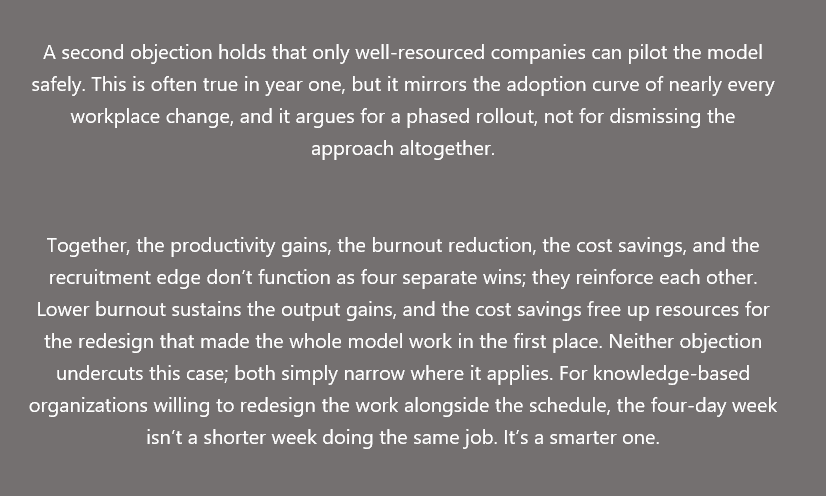
Habits That Weaken a 900 Words Essay
| The Habit | The Correction |
| A fifth point sneaks in because there’s room | Fold it into an existing point, or cut it |
| The scope paragraph just restates the thesis | Use it to state what the claim covers and what it doesn’t |
| The second objection gets skipped entirely | Give it one tight paragraph, even if it’s short |
| The major objection gets answered without being conceded first | Grant what’s fair before explaining why the thesis holds |
| The conclusion lists the four points again | Show how the points and objections connect instead |
| Drafting starts before the outline is locked | Sequence the whole essay first |
Quick FAQs About Writing a 900 Words Essay
Does it matter if the final draft runs slightly over or under 900 words?
Not usually, unless an exact count was specified. Anywhere between roughly 850 and 950 words is normal.
How many pages does a 900 words essay fill?
About a page and three-quarters single-spaced, or close to three and a half pages double-spaced.
How much time does a 900 word essay typically take?
With the topic and outline already settled, somewhere between 100 minutes and two and a half hours, including a final read-through.
What This Comes Down To
A 900 words essay doesn’t ask you to say more than an 800-word one does. It asks you to defend what you’ve already said against a second kind of pushback, not just the first one that comes to mind.
So, pick four points that can actually take a hit, draw a clear line around what your claim covers, concede before you answer the objection that could genuinely sink the argument, and don’t skip the smaller one just because it’s easier to ignore.
Just get all of that right, and the extra hundred words stop feeling like more to write. They start feeling like the room the argument needed to actually hold up.

WordlyCove is a peaceful space where words, writing, and knowledge come together, an ideal platform for writers and learners.
