A proposal usually gets judged faster than most people expect. Within the first few moments, the reader is already trying to figure out three things:
- What is being proposed?
- Why does it matter?
- Can this person actually deliver it?
If those answers are not immediately clear, even a strong idea can quickly lose momentum.
That’s why writing a proposal is not just about presenting information; it is about presenting it in the right order and with the right level of clarity. But if you don’t know how to do that, then check out this blog post!
Here, we’ll guide you on how to write a proposal with a step-by-step approach. But first, we’ll get started with an essential prerequisite. So, let’s begin!
Prerequisite: Start With Decision Clarity, Not Writing
Before writing a single section of your proposal, you should first define the following:
What the reader is actually trying to decide.
For instance, in most professional contexts, this decision usually comes down to three questions:
- Is this solving a real, current problem?
- Can I trust the execution?
- Is the outcome worth the investment?
If your proposal doesn’t naturally answer these, it will struggle to convert, regardless of how well you’ve written it!
In fact, this pattern is quite common in client-facing proposal workflows, especially the ones that are related to SEO, service-based, or web projects, where decisions are comparison-heavy and fast.
How to Write a Proposal With a Clear Logical Sequence
Now that the understanding of the essential prerequisite is out of the picture, let’s get to the elephant in the room!
Remember that a strong proposal writing format is not about having a rigid structure—it’s about making things easier for the readers to understand. Plus, each section should feel like it leads naturally into the next.
So, considering all that, let’s get right into proposal writing now!
1) Use Problem Framing That Reflects the Reality
Most proposals either generalize the problem or over-explain it. But neither works!
Why?
Well, a strong proposal writing focuses on specific observable issues, instead of abstract descriptions. This means that, rather than saying something like this:
“Businesses struggle with low engagement…”
You should use something grounded like this:
“Your landing page is receiving consistent traffic, but engagement drops within seconds, indicating users are not finding immediate clarity in the value proposition.”
This (specific, observable, and tied to outcomes) is the approach that experienced consultants and writers typically use to frame issues in real proposal environments.
2) Solution That Feels Like the Only Logical Next Step
In strong proposal writing, the solution should not feel ‘introduced’—it should feel inevitable. This means that your proposal should connect directly from problem to resolution.
So, based on this, here is a perfect example:
“To address this, I would restructure the landing page into a clearer conversion-focused flow, improving hierarchy, simplifying messaging, and optimizing call-to-action placement to reduce early-stage drop-off.”
As you can see, there is no exaggeration or sales language here—just pure direct alignment with the problem. This sort of clarity is especially effective in project proposal writing, where readers usually respond better to precision than persuasion. And if communicating ideas clearly is something you regularly struggle with, improving your overall writing skills can make a noticeable difference in how professional your proposals feel.
3) Scope Definition That Removes Uncertainty
Having unclear boundaries is one of the most common reasons proposals get delayed or rejected. Therefore, a well-written proposal should clearly separate what it includes and what it doesn’t. Here’s how:
What Is Included:
- Landing page restructuring
- Mobile responsiveness optimization
- UX and content refinement
What Is Not Included:
- Backend development changes
- Full brand redesign
- Paid marketing setup
And this level of clarity isn’t just essential for formatting; it actually reduces the risk for the decision-maker.
4) Execution Plan That Feels Controlled and Realistic
In professional environments, especially in service-based industries, the clarity of execution is a trust factor, regardless of whether you’re writing a report or a proposal. For this reason, a strong proposal includes a simple phased structure like this:
Phase 1: Analysis (2–3 Days)
Review existing performance data and identify drop-off points in user flow.
Phase 2: Implementation (4–6 Days)
Redesign structure, refine messaging hierarchy, and improve visual flow.
Phase 3: Optimization (2–3 Days)
Finalize responsiveness, adjust copy, and validate usability improvements.
As is obvious, this example of an execution plan perfectly reflects how real-world project proposals are usually evaluated—by predictability, instead of complexity. So, by showing such a clear step-by-step path that feels achievable rather than overwhelming, proposals earn confidence.
5) Timeline That Strengthens Trust
A realistic timeline is a credibility signal. How?
Well, if your timeline feels rushed, the proposal will feel risky. But if it feels padded without reason, the proposal will feel inefficient. Therefore, the best approach is to balance these three factors:
- Include buffer time for revisions
- Account for feedback loops
- Avoid overpromising delivery speed
For instance, instead of writing something like this:
“The entire project will be completed within 24 hours.”
Go for a more realistic and professionally grounded approach like this:
“The project is expected to take approximately 7–10 days, including time for revisions, feedback implementation, and final optimization.”
But why do you need to do that?
Well, that’s because experienced professionals in proposal-based work rarely optimize for ‘fast’; they optimize for ‘reliability.’
6) Budget With Justification, Not Just Numbers
In most business proposal writing, cost is rarely the issue. The real problem is having an unclear value logic.
This means that while writing a proposal, you can’t just list pricing alone. Instead, you should connect it to outcomes. Here’s how:
“The investment covers end-to-end restructuring focused on improving conversion performance, rather than surface-level design changes. The goal is measurable improvement in user engagement and conversion flow efficiency.”
As you can see, we’ve shifted the framing from cost to value impact. And that’s the perfect sweet spot in proposal writing.
7) Proof That Feels Relevant, Not Generic
Credibility in proposal writing should be selective. But how?
Well, in simple terms, it should support the claim, rather than dominating the document. And here’s an example that perfectly indicates how you can do that:
“In a previous landing page optimization project, restructuring content hierarchy and simplifying navigation improved engagement behavior significantly by reducing early user drop-off.”
This strategy will work because it doesn’t sound overly self-promotional. Plus, it is outcome-focused and relevant to the current proposal. So, that’s how you should do it as well!
Real Example — A Complete Mini Proposal
In light of the structure and examples we’ve shared above, here is a short but effective proposal:
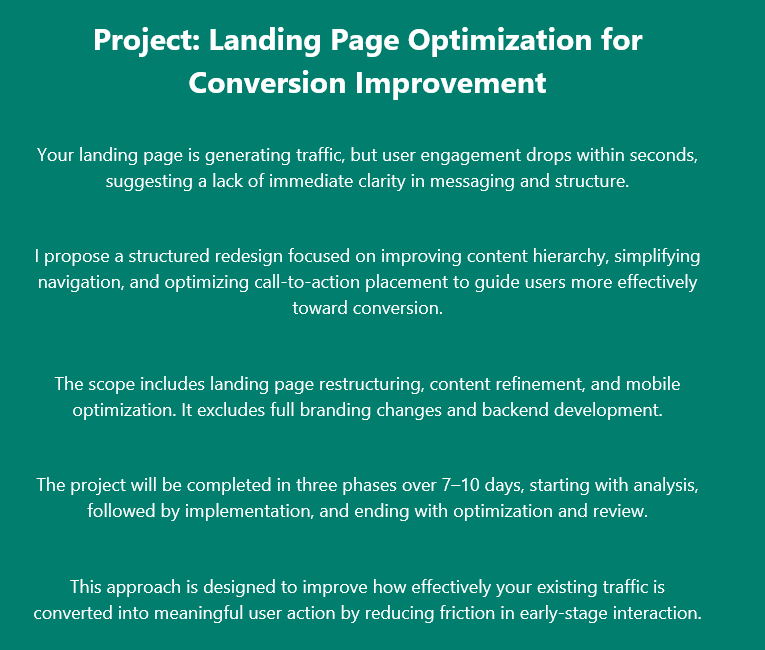
See how everything feels clear, decision-ready, and structured? That’s how you should write proposals in real client-facing environments!
Common Reasons Proposals Fail (Even When Strong)
Based on real-world proposal patterns that we’ve analyzed and seen, we believe that most rejections come from the following issues:
- Lack of clarity in early sections
- Missing or vague scope boundaries
- Overly complex execution explanations
- Reader uncertainty about outcomes
- Unrealistic or unclear timelines
- Weak connection between the problem and the solution
And as is obvious, none of these are content-related issues; they are actually clarity problems.
A Proposal Pre-Send Checklist
Before sending any proposal, check for these signs:
- Can the problem be understood in one reading?
- Does the reader understand the value without effort?
- Does the solution feel naturally connected?
- Is the execution plan predictable?
- Is the scope completely unambiguous?
If any answer is unclear, then don’t send the proposal because it’s not ready yet!
Concluding Remarks
All in all, a strong proposal is not persuasive because it tries to convince. It is effective because it removes uncertainty. That’s because when clarity replaces interpretation, decision-making becomes simple and approval becomes the natural outcome. And that‘s the real difference between a written document and a winning proposal.

WordlyCove is a peaceful space where words, writing, and knowledge come together, an ideal platform for writers and learners.
