Paraphrasing can surely help eliminate plagiarism and improve your text quality. However, these advantages are only possible if you paraphrase something properly.
Speaking of proper paraphrasing, you should be aware of its technical and ethical guidelines to implement this technique correctly. And that’s where this discussion will come in handy.
In this blog post, we’ll go over the technical and ethical guidelines of paraphrasing to clear up any doubts on the practical implementation of this writing skillset.
So let’s get started here. Shall we?
Ethical Rules of Paraphrasing
Paraphrasing is more than just a writing skill—it’s a whole responsibility.
Why?
Simply because when you replace someone else’s ideas or words, you basically handle intellectual property. For this reason, when you paraphrase, ethical boundaries matter as much as writing quality.
So, here is a list of those essential ethical rules:
1) Preserve the Original Sense of the Source
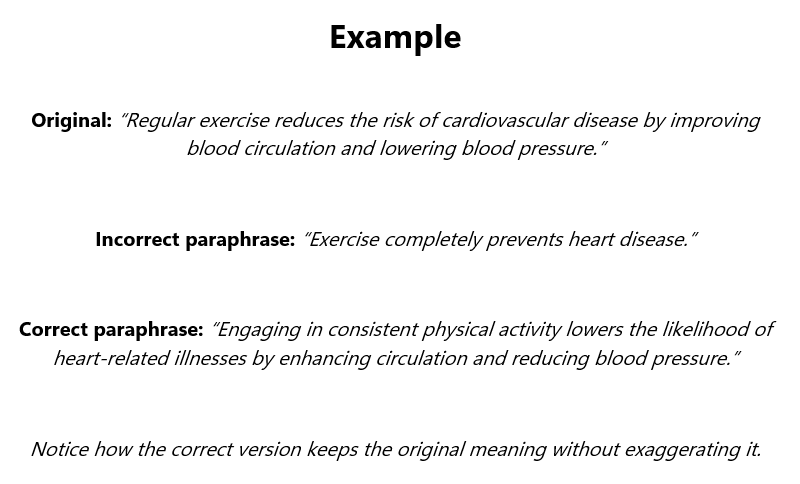
Paraphrasing requires preserving the original meaning. So, when it comes to ethically rephrasing something, you don’t change the meaning in order to fit the information into your context.
Surely, you can explain or re-express it, but you can’t twist the intended meaning because that would be intellectually dishonest.
2) Avoid Patchwriting
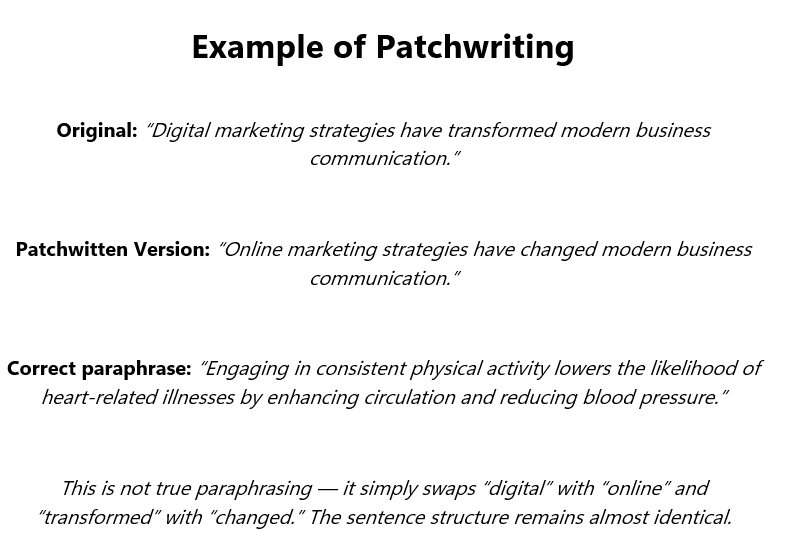
Patchwriting is something where you make your text unique in patches. For instance, you slightly modify the structure of sentences, but you don’t make any changes to the original phrasing at all.
Following such a practice often results in accidental plagiarism because true paraphrasing requires a complete understanding of the source before restating.
3) Do Not Use Synonym-Replacement Alone
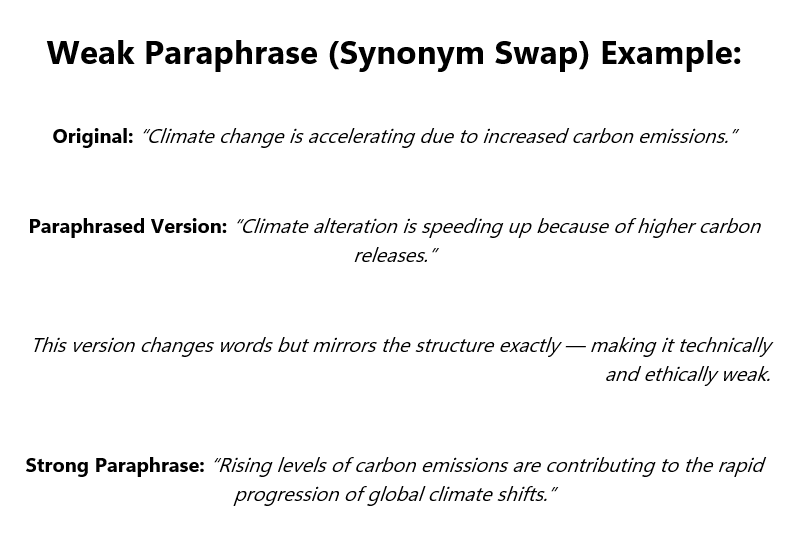
Nowadays, especially in this AI-dominated era, people have been using paraphrasing tools to quickly restate an existing idea. However, most of these options only make surface-level changes.
For instance, they swap a few words for synonyms, but the original structure remains unchanged. So, this practice is an example of ethically weak paraphrasing because this way, you don’t gain an understanding of the source. And since the core structure remains the same, it’s an indication of improper paraphrasing.
4) Always Credit the Original Source
Paraphrasing something does not make you the original owner; you still need to cite the original source. This is especially true for situations where you restate someone else’s information, be it an idea or wording.
So, whether you’re restating the insights from an academic journal or a published book, you should acknowledge the original information author. Failing to do so would result in plagiarism, which can nowadays be detected by cutting-edge plagiarism checkers.
5) Maintain Transparency
The concept of ethical paraphrasing is all about respecting academic integrity, authorship, and ideas.
Therefore, whenever you restate someone else’s ideas or words, you should always be transparent—tell others that you’re using someone else’s ideas or words. Doing so will help you build credibility.
Technical Aspects of Paraphrasing
Now that we’ve established the ethical foundation, let’s further expand on the actual use of this skillset. So, here are the technical aspects that you should master to create effective paraphrases:
1) Keep Reading Until You Fully Understand the Source
You can’t paraphrase something if you don’t know its intended meaning or intent. So, before writing the paraphrased version, read the original source multiple times.
And while doing so, you should highlight the following sections in the source:
- Main argument
- Supporting points
- Key terms
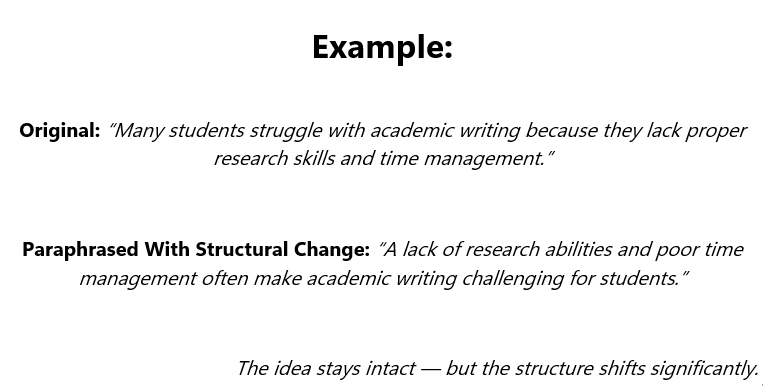
2) Don’t Modify the Words Alone, Change the Structure
Once you’ve identified the core idea after reading, it’s time to temporarily put the source aside. And then, start writing the paraphrased version.
Now, as we’ve already mentioned, ethical paraphrasing is not just about swapping words for synonyms—you also need to change the sentence structures. And for that, you can:
- Break long sentences into shorter ones
- Combine short sentences into complex ones
- Convert active voice to passive (or vice versa)
- Reorder ideas
3) Use Your Natural Writing Voice
When you’re restating something, it should look like you’ve written it. Right?
Therefore, use your own unique and natural writing style and tone while writing the paraphrased version of the information.
4) Keep Key Terminology When Necessary
Some terminologies, like established theories and scientific names, can’t or shouldn’t be changed during paraphrasing. Why?
Simply because if you modify them, it can reduce the accuracy and clarity of the whole thing. So, keep them unchanged!
5) Compare With the Original Version
Once the paraphrased version is ready, you should cross-check it with the original source. And for that, use the following checklist:
- Are phrases too similar?
- Did you accidentally keep technical phrasing unchanged?
- Is the sentence pattern identical?
Note: A helpful practice is to wait 10–15 minutes after writing your paraphrase before comparing it to the source. This creates mental distance and reduces unconscious structural copying.
If the answer to all or any of these questions is ‘yes,’ you should redo the whole paraphrasing bit.
6) Cite Properly
And finally, use the specified citation style (APA, MLA, or Chicago) to give credit to the original information owner properly. Why?
Simply because doing so will help ensure technical accuracy in paraphrasing, which is as important as the actual restating.
FAQs
What are some major ethical considerations while paraphrasing?
Some primary ethical considerations about paraphrasing are as follows:
- Don’t copy the phrasing or structure
- Be transparent about the borrowed ideas
- Cite the original reference properly
- Keep the original meaning unchanged
What are the seven steps of paraphrasing?
The 7 essential steps for paraphrasing any type of text are as follows:
- Read carefully
- Find the main idea
- Jot down the key details
- Keep the source aside
- Restate the whole thing in your own voice
- Do a check for similarity
- Cite correctly
Will Turnitin detect AI in my content if I paraphrase it?
If your paraphrased text still features AI patterns, Turnitin will instantly flag it because paraphrasing alone can’t guarantee prevention from AI detection. Instead, you should also add your own unique examples and insights.
Conclusion
There is more to paraphrasing than simply swapping words for appropriate synonyms. In fact, this writing skillset is more about precision and responsibility. For instance, when you apply the right technical strategies and follow all the ethical principles, you do a good job at protecting academic integrity. Therefore, whenever you want to paraphrase, you should always change the structure thoughtfully and cite the source properly. And before finalizing, always verify the accuracy. In this way, you will not only avoid plagiarism but also become a credible and sharper writer.

WordlyCove is a peaceful space where words, writing, and knowledge come together, an ideal platform for writers and learners.
