
Most people start a poem with a clear idea and still end up with something that feels flat on the page.
But why?
Well, the issue isn’t a lack of ideas; it’s not knowing how to shape them into lines that carry weight. And that’s where most attempts at poem writing break down.
But don’t you worry because this guide focuses on that exact gap.
In this blog post, you won’t just learn how to write a poem; you will see how a poem develops step by step, using one idea from the first draft to the final version. So, without further ado, let’s dig in!
How to Write a Poem in 9 Simple Steps — A Complete Breakdown
Let’s keep things direct and practical, right off the bat!
So, here is a simple step-by-step workflow that you can use to write a poem from start to finish:
Step 1: Define the Emotional Core (Not the Topic)
Let’s be honest, if your starting point is unclear, then your poem will be vague as well. So, instead of beginning with something broad, you should focus on what the poem actually feels like.
For instance, a weak starting point will look something like this:
This poem is about waiting.
On the other hand, a stronger one looks like this:
This poem is about the quiet realization that someone isn’t coming.
Such a shift matters because one just represents a situation, while the other clearly defines a feeling. You can even fine-tune the above-written stronger starting point in the following way:
Waiting for someone, slowly realizing they won’t come.
And in this way, you will lay a strong foundation for your poem.
Step 2: Choose the Structure Intentionally
Structure plays a major role in how your poem is experienced. So, even if you’re not using strict rules, you will still need to make a clear decision here, at this step.
In this case, we’ll use free verse, but with:
- Short, controlled lines
- A slow, reflective pace
- Clear visual spacing
This ensures that the poem feels restrained instead of scattered. And once this is clear, you’ll automatically begin to understand how your poem should move.
Step 3: Write the First Draft Without Editing
When writing your first draft, you shouldn’t aim for perfection at all. Instead, your goal should be to craft raw material.
So, write continuously and don’t stop to fix anything. Just to put your mind at ease, here is an example of a first draft of a poem:
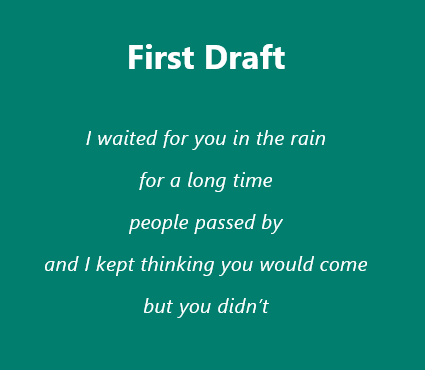
As you can see, the poem feels quite flat here, which is fine at this stage. That’s because you only need to capture the situation right now.
Step 4: Replace Abstract Language With Concrete Detail
This is the stage of poem writing where your poem actually starts working. That’s because if you implement this correctly, your lines won’t stay vague. And as a result, your readers will connect with your poem better.
So, based on the example used in the third step, here are some weak phrases:
- For a long time
- I kept thinking
- People passed by
But why are they weak?
Well, they explain things, but they don’t show anything. So, what you need to do is replace such phrases with something visible.
The picture below features a rewritten version of the first draft:
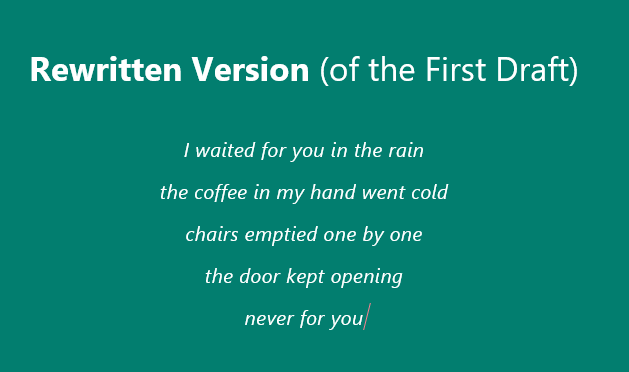
And this version will work because:
- ‘Coffee went cold’ shows time passing
- ‘People passed by’ has been replaced by ‘chairs emptied’
And as a result, the whole scene looks easier to visualize, which will eventually make it easier for readers to step inside the moment.
Step 5: Shape Line Breaks to Control Meaning
At this point, your poem may have become easier to visualize, speaking from the perspective of the example we wrote in the fourth step. However, if you analyze that deeply, it still looks like a series of loosely broken sentences.
Therefore, you need to shape your line breaks with intention here. But why?
Well, line breaks control:
- Where the reader pauses
- What gets emphasized
- How tension builds
And based on this, here is a more refined structure of the example used in the fourth step:
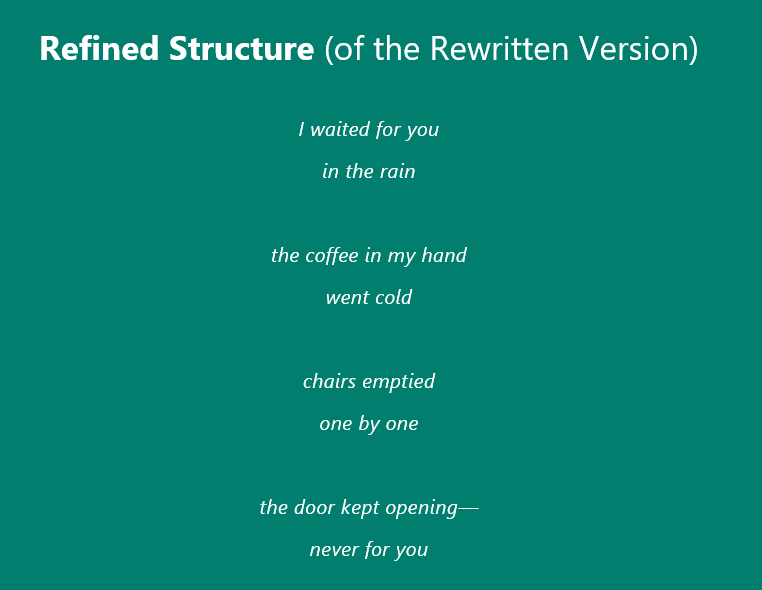
As is obvious, the lines have become shorter, which will slow down the reading. Plus, breaks have been implemented strategically, which will isolate important moments. And finally, the phrase ‘never for you’ lands with more weight.
So, if you do this, your writing will actually start to feel like poetry instead of plain text.
Step 6: Cut With Intent and Not Caution
Now, we know that the above poem has started sounding good. But in this stage, you will have to cut some phrases with proper intent, instead of caution.
Now, hesitation at this phase is normal because most writers struggle to remove lines that sound good. However, such hesitation often weakens the poem. So, at this stage, you need to question every detail.
For instance, in the light of the above example, you can ask yourself something like this:
Does ‘in the rain’ add something essential—or is it just expected?
And in this way, you can begin the removal phase and test the result.
Here is a stronger and trimmed-down version of the poem written in the fifth step:
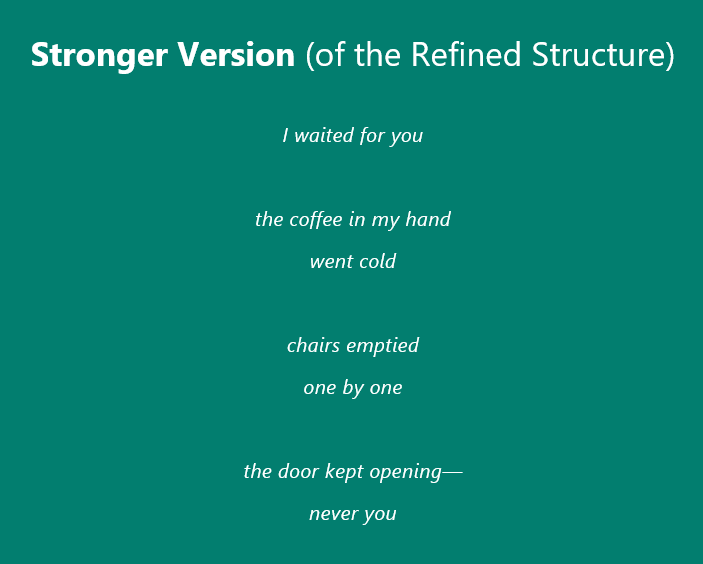
Now, you might be wondering, why does this new version feel better?
Well, that’s simply because of the following factors:
- Removing ‘in the rain’ forces stronger imagery to carry the poem
- The tone has become more internal instead of decorative
And this is what real editing looks like, where you remove good lines for stronger ones.
Step 7: Refine Rhythm (and Add Subtle Tension)
A poem shouldn’t just read smoothly; it should feel natural as well. And right now, the rhythm of the above-written poem is fine, but it feels slightly too even.
For this reason, you can now introduce a small disruption to improve it. Here’s how:
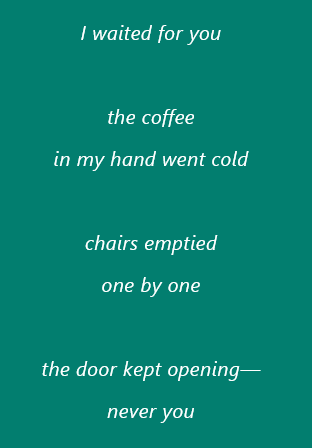
Now, the small change of breaking ‘the coffee / in my hand’ creates a pause. And that pause reflects hesitation, which now makes the rhythm more capable of supporting emotions better.
Step 8: Strengthen the Ending
When writing a poem, your ending should land naturally instead of explaining everything. And as of now, our current version ends like this:
never you
It works, but from an expert perspective, we feel like it seems slightly predictable. So, here is how we’ve improved it:
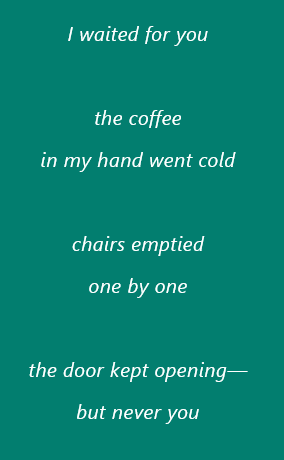
Now, in this version, ‘but’ introduces contrast naturally, which feels like a realization. As a result, the poem ends without overexplaining.
Step 9: Step Away and Revisit
Once your poem is complete, don’t finalize it immediately. Instead, you should take a break and revisit it later. And in this way, you will notice the following things:
- Lines that feel unnecessary
- Places where wording can be tighter
- Small rhythm issues
So, after fixing these, your poem will feel more refined overall.
Common Mistakes That Weaken Poems
After learning the nine essential steps to writing a poem, it is just as important to recognize what can hold your work back. Why?
Well, even strong poem writing can lose impact if certain missteps creep in. So, below are some common mistakes you should avoid when crafting a poem:
- Adding unnecessary metaphors just to sound poetic often makes the poem feel forced.
- Explaining the meaning at the end reduces the impact because it leaves nothing for the reader to interpret.
- Ignoring line breaks completely removes control over emphasis and pacing.
- Using abstract emotional words instead of imagery makes it harder for readers to connect with the poem.
- Writing everything in one draft and stopping there makes the poem feel incomplete because first drafts are never proper material.
So, once you start identifying and correcting these patterns, your poetry will improve naturally over time, which will also strengthen your overall writing skills.
Concluding Remarks
To sum up our entire discussion, you may have observed that the final version of the poem didn’t come from inspiration; it actually came from the following deliberate decisions:
- Turning vague ideas into specific images.
- Controlling pacing through line breaks.
- Removing anything that dilutes the impact.
- Letting the ending imply instead of explaining.
Skip any of these steps, and your poem will weaken.

WordlyCove is a peaceful space where words, writing, and knowledge come together, an ideal platform for writers and learners.
