Finding a research topic is often easier than finding something meaningful to study within that topic. In fact, that’s why many researchers start with a broad idea but struggle to identify what their study can contribute that previous research has not already covered.
Such missing pieces in existing knowledge are known as research gaps.
But what is the exact definition of a research gap? More importantly, how can you find one in your study?
That’s exactly what we’re going to explore in this blog post.
So, keep reading!
What Is a Research Gap? — Understanding Its Definition & Overall Concept
A research gap is an inconsistency, limitation, unanswered question, or unexplored area in existing research that creates an opportunity for further investigation.
In simple terms, it is something that previous studies have not fully explained, explored, or tested.
However, research gaps do not necessarily mean that nobody has studied a topic before. In many cases, a topic may already have hundreds of studies, but researchers may still find gaps because previous studies:
- Examined a different population
- Focused on outdated contexts
- Ignored certain variables
- Left some questions unanswered
- Produced conflicting findings
- Used limited research methods
However, let’s use an example to better understand this concept.
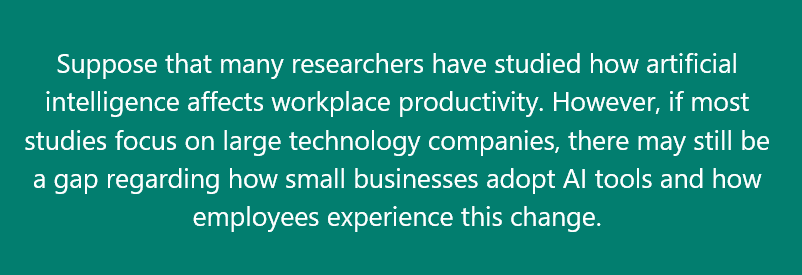
So, in light of this example, a research gap connects what is already known with what still needs to be discovered.
The 5 Different Types of Research Gaps
Research gaps can appear in different forms depending on the research area.
So, below are some of its most common types:
Population Gap
A population gap exists when previous research focuses on a specific group while ignoring another relevant population. For example,
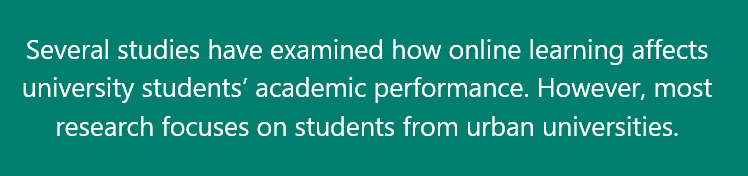
So, in this example, the research gap is as follows:
The impact of online learning on students from rural educational institutions remains underexplored.
And the possible research direction here could be this:
Studying the challenges and outcomes of online learning among rural students.
Methodological Gap
A methodological gap occurs when previous studies rely on limited research methods, leaving room for investigation through different approaches. For example,
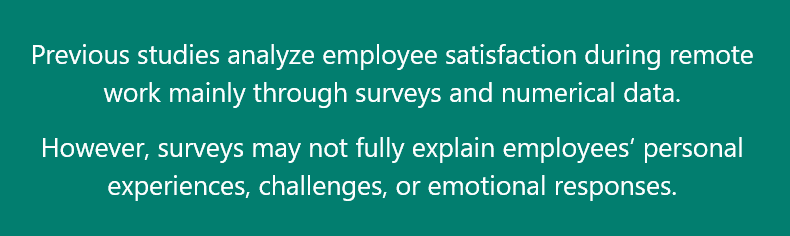
So, in this example, the research gap is as follows:
The deeper experiences of employees working remotely require a qualitative investigation.
And the possible research direction here could be this:
Conducting interviews to explore how remote workers perceive work-life balance and workplace connection
Knowledge Gap
A knowledge gap exists when researchers do not have enough understanding of a particular phenomenon, process, or relationship. For example,
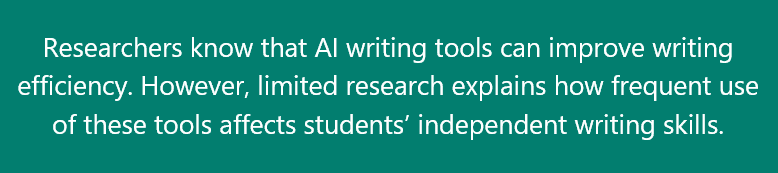
So, in this example, the research gap is as follows:
The long-term impact of AI writing assistants on students’ writing development remains unclear.
Theoretical Gap
A theoretical gap appears when existing theories do not completely explain a new situation or a changing context. For example,
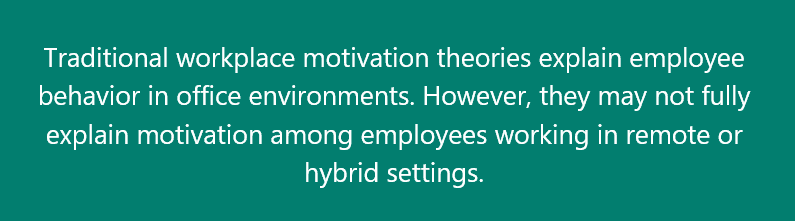
So, in this example, the research gap is as follows:
Existing motivation theories need further examination in modern flexible work environments.
Contradictory Findings Gap
This gap occurs when previous studies reach different conclusions about the same topic. For example,
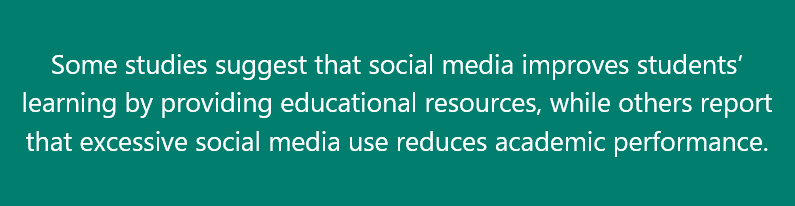
So, in this example, the research gap is as follows:
The factors determining whether social media produces positive or negative academic outcomes remain unclear.
How to Find a Research Gap in Your Study in 7 Simple Steps
Now that you’ve understood the different types of research gaps, let’s move on to our next goal—finding a research gap.
The reality is, finding a research gap requires more than searching for a topic that nobody has studied.
In fact, most valuable gaps are discovered by carefully analyzing existing research and identifying what remains incomplete.
So, the following process can help you systematically find a research gap for your study:
Step 1: Start With a Broad Research Topic
Before searching for a gap, clearly understand the research area you want to explore.
But why?
Well, at this stage, your goal is not to find an unanswered question directly.
Instead, it is to explore the existing discussions around your topic. And for that, you should:
- Choose a broad research area.
- Search for recent academic studies.
- Identify the major themes researchers are discussing.
- Understand what aspects have already been explored.
So, let’s use an example to better understand the practical implementation of this step.
Suppose that your initial topic is this:
“Artificial intelligence and employee productivity.”
So, before identifying a gap, explore questions such as:
- Which industries have researchers studied?
- What AI technologies have been examined?
- How is productivity measured?
- What limitations do researchers mention?
And after reviewing existing studies, you may discover that most research focuses on large corporations.
So, such an observation creates a direction for finding a possible gap.
Step 2: Conduct a Structured Literature Review
A literature review is one of the most effective ways to discover research gaps because it shows you what researchers already know and what remains unanswered. So, instead of simply reading papers, you should organize your findings. And for that, you can:
Create a literature comparison table with details such as:
| Research Study | Topic | Method Used | Key Finding | Limitation |
| Study A | AI adoption in businesses | Survey | AI improves efficiency | Focused only on large companies |
| Study B | Workplace AI usage | Interviews | Employees have adoption concerns | Small sample size |
And then look for patterns.
To do that, simply ask yourself the following questions:
- Which areas appear repeatedly?
- Which groups are missing?
- What limitations appear frequently?
- What questions remain unanswered?
Sounds confusing?
Let’s use an example to understand this better.
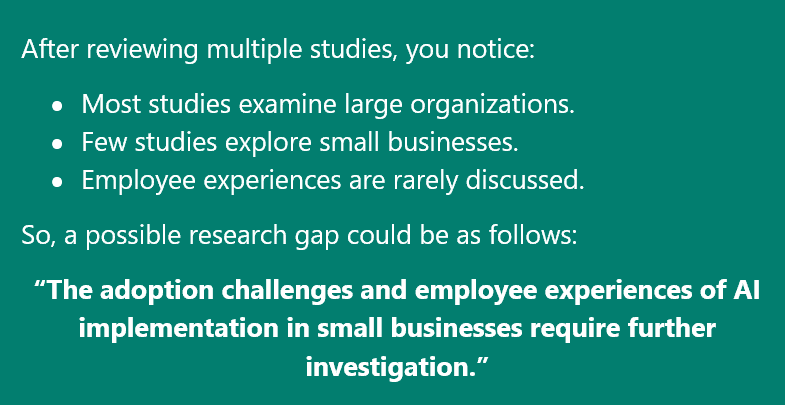
Step 3: Analyze Research Limitations
At the end of research papers, researchers often mention limitations, such as the following:
- Limited geographic locations
- Restricted variables
- Short research durations
- Small sample sizes
- Specific participant groups
So, such limitations can directly reveal possible research gaps.
Therefore, when reading research papers, you should pay attention to the following sections:
- Conclusion
- Discussion
- Future research directions
- Limitations
And while doing so, look for statements like:
- “Further investigation is needed…”
- “Future research should examine…”
- “This study was limited to…”
But let’s use an example to better understand this!
Suppose that a study examines the relationship between social media usage and academic performance among university students in one country. And the researchers mention that results may differ among students from other educational backgrounds.
So, in such a situation, a possible research gap could be something like this:
“The relationship between social media usage and academic performance among high school students across different regions remains insufficiently explored.”
Step 4: Identify Missing Variables or Relationships
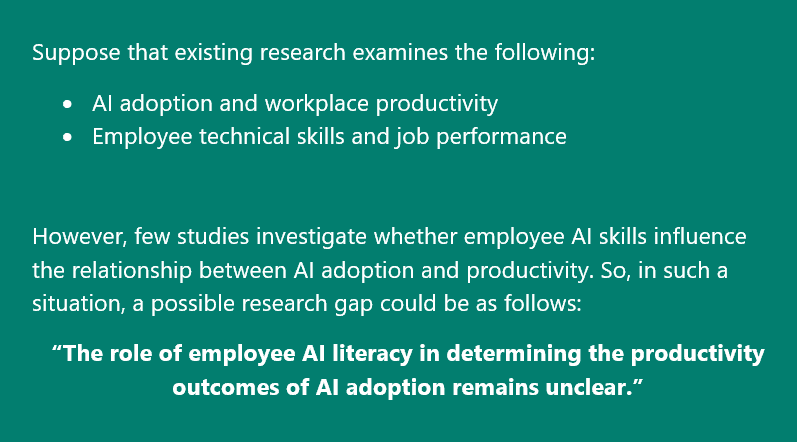
Sometimes, previous studies examine individual factors but fail to explore how different factors interact.
So, you should also look for variables that researchers have studied separately but not together. And what you can do is:
Compare existing studies and ask questions like these:
- What factors have researchers already examined?
- Which possible relationships have been ignored?
- Are there factors that may influence existing findings?
However, let’s use an example to better understand this!
Step 5: Look for Contradictions Between Studies
Conflicting findings often indicate that researchers still do not fully understand a topic.
So, what you can do is:
Compare conclusions from different studies.
And for that, you can ask the following questions:
- Are other factors influencing the outcomes?
- Are they studying different populations?
- Are they using different methods?
- Why are researchers reaching different results?
Sounds confusing? Let’s again use an example to understand this better!
Let’s say that you review studies about remote work productivity. And while doing so, you find that:
- Study A reports that remote work improves productivity.
- Study B suggests remote work decreases collaboration and performance.
- Study C finds no significant impact.
But instead of choosing one conclusion, you should investigate why these differences exist. And doing so could lead you to the following potential research gap:
“The factors influencing whether remote work improves or reduces employee productivity require further exploration.”
Step 6: Explore New Contexts, Populations, or Settings
A topic can have extensive research and still contain gaps when studied in a different context. Therefore, a change in location, population, industry, or environment can create a new research opportunity.
So, what you can do is:
Take an existing research topic and ask the following questions:
- Has this been studied in my target population?
- Has it been examined in my region?
- Does a different environment change the outcome?
But how will this be helpful? Let’s take assistance from an example to understand this!
Many studies analyze online education platforms among university students in developed countries. However, fewer studies explore online education challenges among students with limited internet access in developing regions. So, in such a scenario, a possible research gap could be something like this:
“The effectiveness of online learning platforms among students with limited digital resources requires further investigation.”
Step 7: Use Keyword Mapping to Discover Underexplored Areas
Keyword mapping helps you identify which concepts frequently appear together and which connections are missing.
So, take your main research topic and list related keywords.
But how?
Let’s use an example to understand this step better!
Suppose that your main topic is as follows:
AI adoption in education
So, in such a situation, its related keywords will be something like this:
- Artificial intelligence
- Student learning
- Academic performance
- AI tools
- Critical thinking
- Learning outcomes
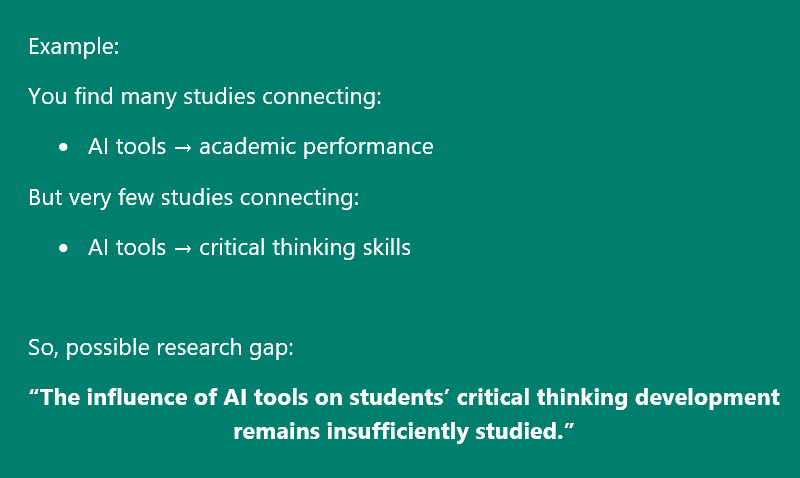
Now, what you need to do is examine which relationships appear frequently in existing studies.
Here is how all of this will look practically:
Concluding Remarks
To sum up, finding research gaps is a process of understanding what existing studies have already discovered and identifying what still needs further investigation. So, start by exploring your research topic, reviewing existing literature, analyzing limitations, comparing findings, and looking for missing relationships or unexplored contexts.
But remember that a well-identified research gap does not come from simply finding a topic with fewer studies. It actually comes from discovering a meaningful unanswered question that can add new knowledge to your field.

WordlyCove is a peaceful space where words, writing, and knowledge come together, an ideal platform for writers and learners.
