You probably use ‘that’ and ‘which’ on a daily basis—sometimes correctly, but most of the time interchangeably and without realizing it.
But here is the problem: While people have been using these two relative pronouns interchangeably, they are not the same. In fact, using the incorrect version might subtly change the meaning of your statement from a grammatical perspective.
However, this ends with this blog post, which breaks out the which vs that debate in simple terms.
So, let’s begin!
What Is the Difference Between ‘Which’ and ‘That’?
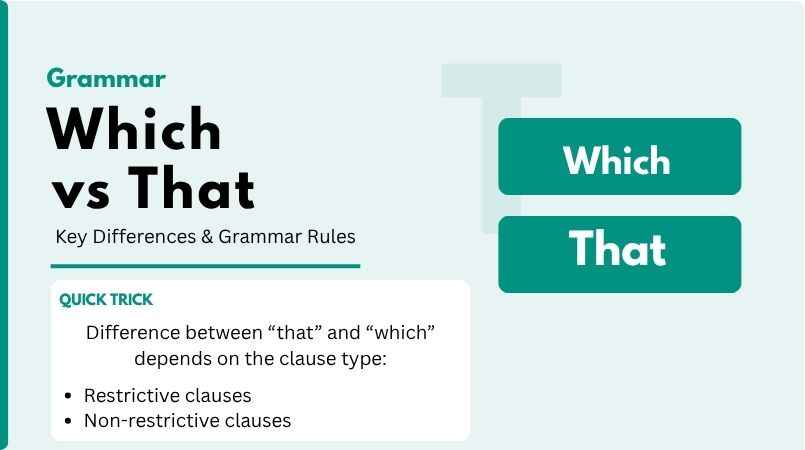
The major difference between ‘that’ and ‘which’ depends on the type of clause they introduce.
For instance, in this debate, there are two types of clauses:
- Restrictive clauses (essential information)
- Non-restrictive clauses (non-essential information)
Restrictive clauses use ‘that’ because they convey vital information. Non-restrictive clauses use ‘which’ followed by a comma (,) to present non-essential information.
Sounds confusing?
Let’s simplify it!
When to Use ‘That’
Use ‘that’ with a restrictive clause, where the sentence would feel incomplete or not make sense without it. For instance, consider the following sentence:
The book that is on the table belongs to me.
Here, the clause ‘that is on the table’ defines which book in this example. Right? And if you delete it, the sentence will become ambiguous (The book belongs to me), since no one will know which book we are discussing. So, that’s why we’ve used ‘that’ here.
Similarly, consider another example:
Students that study consistently perform better.
In this sentence, the clause limits the group of students. Right? And without it, the statement would be incomplete.
So, it is essential. And that’s the reason for using ‘that’ here.
The Validity of the Comma Rule
As you may have noticed in the above examples, we haven’t used commas with ‘that.’ This is because restrictive clauses do not require them.
✔ Correct Example: The car that I bought is electric.
✘ Incorrect Example: The car, that I bought, is electric.
When to Use ‘Which’
Use ‘which’ with a non-restrictive clause—something that adds additional information or value to a sentence. For instance, consider the following sentence:
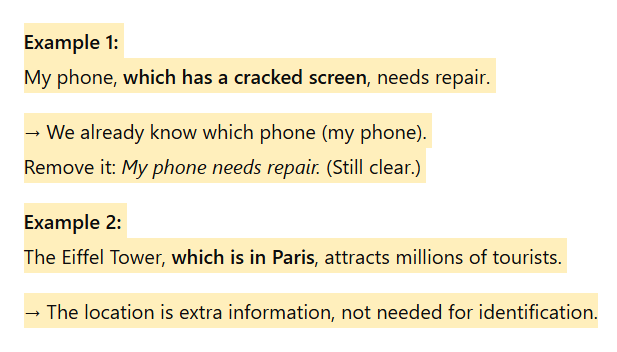
My laptop, which I bought last year, is already slow.
Here, the clause ‘which I bought last year’ provides additional detail because without it, the whole sentence (My laptop is already slow) would still be meaningful. So, that’s the reason for using ‘which’ here.
Let’s consider another sentence to further clarify the usage of ‘which’:
The Eiffel Tower, which is in Paris, attracts millions of tourists.
Now, we already know that the Eiffel Tower is in Paris. Right? So, the clause ‘which is in Paris’ just provides additional detail, which means that without it, the sentence would still be complete. Right?
So, that’s why we’ve used ‘which’ here.
The Validity of the Comma Rule
To separate non-restrictive clauses (or clauses that feature non-essential information), it is necessary to use a comma (,). Here’s an example that will help you better understand this:
✔ Correct: The house, which has a red door, is mine.
✘ Incorrect: The house which has a red door is mine. (In formal American English)
Easy Tricks to Remember the ‘Which vs That’ Difference
Now that all the concepts are clear, let’s share a quick memory trick to help you easily remember this difference.
- If the clause features essential information, use ‘that.’
- If the sentence can be completed without the clause (i.e., the clause just contains additional details), use ‘which’ with a comma (,).
Examples Table of Correct Usage
To better understand the ‘which vs that’ difference, have a look at the following table that features several examples from diverse use cases:
| Sentence | Clause Type | Correct Variation—Which Vs. That | Why It’s Correct |
| My car, which is five years old, runs perfectly. | Non-restrictive | Which | Extra information |
| The cake that she baked was delicious. | Restrictive | That | Specifies which cake |
| The cake, which she baked yesterday, was delicious. | Non-restrictive | Which | Adds extra detail |
| The movie that won the award is streaming now. | Restrictive | That | Identifies the movie |
Frequently Asked Questions About Which vs. That
Can ‘which’ replace ‘that’?
Yes, but this only happens sometimes in informal British English. However, when writing in formal American English, ‘which’ can’t replace ‘that.’
Do style guides agree on this rule?
Absolutely. Most modern American style guides, especially the ones related to academic and professional writing standards, clearly differentiate between restrictive and non-restrictive clauses.
Is it always wrong to use ‘which’ without a comma?
Not always, but in American English formal writing, it is incorrect to use ‘which’ without a comma, especially when dealing with a non-restrictive clause. However, certain style standards are more adaptable in informal settings.
Conclusion
All in all, the confusion between ‘that’ and ‘which’ isn’t something to worry about—everyone has that, even the most experienced writers. However, you can easily clarify it by just remembering this: If the information is essential, use ‘that’ without commas, but if it is extra detail, use ‘which’ with commas. That’s it! So, the next time you hesitate between ‘which’ and ‘that,’ don’t start guessing. Instead, analyze the clause and find out whether it is essential or not. And let the rule decide for you.

WordlyCove is a peaceful space where words, writing, and knowledge come together, an ideal platform for writers and learners.
