Lay and lie may be different forms of the same verb, but they are two completely different words.
In fact, they’re so different that using them interchangeably can change the meaning of the whole sentence. So, if you’ve ever paused mid-sentence to think about whether it’s lay or lie, you should read this blog post.
It will clarify your confusion about lay vs lie by providing the simplest explanation of their key differences and proper usage. It will even share some useful techniques to help you recall the distinction at all times.
So, with that in mind, let’s dive in here!
Lay vs Lie — What Is the Core Difference?
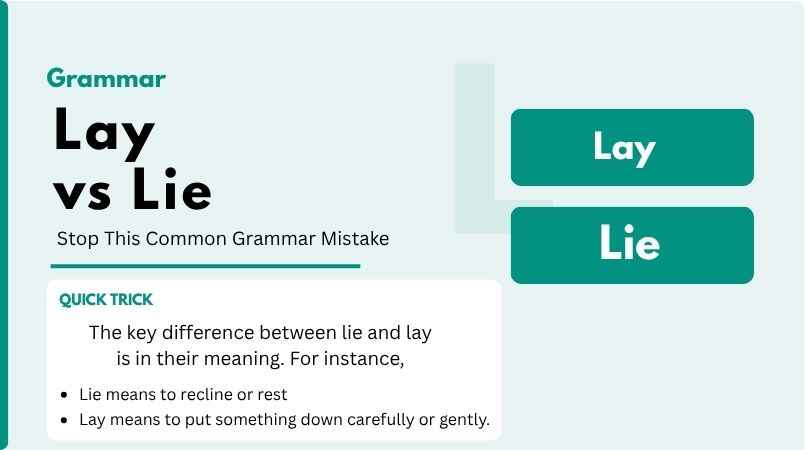
The key difference between lie and lay is in their meaning. For instance,
- Lie means to recline or rest

- Lay means to put something down carefully or gently.

Hence, if you just remember the meaning, you will always use the correct word.
But the big question is: how to actually memorize the key difference?
Well, the next section answers this question perfectly.
How to Remember the Difference and Use Lay & Lie Properly
The word ‘lay’ requires an object, whereas the term ‘lie’ does not. So, if you get confused between these words, you can use the ‘Object Test’ as a quick mental check. But what is that?
Well, the quick self ‘Object Test’ refers to asking yourself the following questions:
Is something being placed somewhere?
- If so, then you should use the word ‘lay.’ Here are two examples to help you understand this terminology better:
Please lay the book on the desk.
She lays the baby gently in the crib every night.
- But if not, then you should use the term ‘lie.’ Here are two examples to help you comprehend this terminology better:
I need to lie down after a long day.
She often lies on the couch while reading.
Even if this sounds confusing? Then, let’s simplify it further.
- If you can replace the verb in a sentence with the term ‘place,’ then ‘lay’ is the right word to use in that particular situation.

- However, if the substitution doesn’t work, then ‘lie’ is the correct terminology in that specific scenario.

Why Do People Get Confused Between Lay & Lie
Now, you might be wondering why people use ‘lay’ and ‘lie’ interchangeably when they have different meanings.
Well, that’s mainly because the form of the verb used for the past tense of ‘lay—to put something down’ is also ‘lie.’
Confusing, right? Well, don’t worry, the following table will help you resolve this confusion once and for all:
| Verb | Present (Simple) | Present Participle | Past (Simple) | Past Participle |
| Lay—to put something down | Lay (I lay the book on the desk every morning.) | Laying (I am laying the book on the desk every morning.) | Laid (Yesterday, I laid the book on the desk.) | Laid (I have laid the book on the desk.) |
| Lie—to recline or rest | Lie (I lie on the couch after work.) | Lying (I am lying on the couch after work.) | Lay (Yesterday, I lay on the couch after work.) | Lain (I have lain on the couch for hours.) |
Some Frequently Asked Questions About Lay vs Lie
Do you ‘lay’ or ‘lie’ on the couch?
Lay would be a wrong choice unless you’re placing something down. To clarify,
For the past tense, you would use ‘lay on the couch’—Yesterday, I lay on the couch all evening. For the present tense, you would use ‘lie on the couch’:
I lie on the couch after dinner.
She is lying on the couch right now.
Do you ‘lie’ or ‘lay’ in bed?
If you’re just resting and not placing anything down, then ‘lie’ is the correct choice. More specifically,
For the past tense, you would use ‘lay in bed’—Yesterday, I lay in bed all morning. For the present tense, you would use ‘lie in bed’:
I lie in bed when I can’t sleep.
She is lying in bed right now.
Does anybody still use ‘lain’?
Yes, people still use ‘lain,’ but only in written or formal English. In everyday speeches or casual communication, people generally avoid this term.
Is ‘laying down’ always wrong?
Well, that depends on what you’re trying to say. For example, ‘laying down’ is correct if you’re referring to placing something down—She is laying the blanket on the bed. However, if you’re referring to reclining, you should use ‘lying down.’
Is the cat ‘lying’ or ‘laying’?
This also depends on the meaning. For instance, if the cat is placing something down (which is rare in normal usage), then ‘laying’ could be correct—The cat is laying a toy on the floor. However, according to most everyday situations, such a scenario usually means that the cat is resting. Therefore, ‘lying’ is the correct form—The cat is lying on the sofa.
Why is ‘lay’ the past tense of ‘lie’?
English inherited irregular verbs from Old English, where ‘lay’ (to put down) and ‘lie’ (to recline) came from different roots. Over time, their past tense forms overlapped: ‘lay’ became ‘laid’ while ‘lie’ became ‘lay.’ That’s why context—whether you mean placing or reclining—is more important than memorization alone.
Concluding Remarks
In conclusion, we want to sign off by saying that ‘lay’ and ‘lie’ may look the same. However, their meanings are totally different—one (lay) places something down, and the other (lie) refers to reclining. So, to make sure that you never become a victim of lay vs lie confusion, just remember the ‘Object Test’ we’ve shared above and understand the past tense forms.

WordlyCove is a peaceful space where words, writing, and knowledge come together, an ideal platform for writers and learners.
