
You can have strong ideas and still end up with a weak essay. That’s because in academic writing, clarity and structure often matter just as much as the content itself.
However, many students underestimate this. As a result, they end up with essays that sound correct in parts but fail to build a clear argument from start to finish.
So, if you’ve also been through this, then keep reading this blog post because it features a comprehensive guide on essay writing.
Whatever you find here will help you meet the updated requirements of both academic and professional contexts. So, with that in mind, let’s get started!
Step 1: Understand the Essay Question Properly
You can’t write an essay effectively if you don’t even know what is being asked. So, before you start writing, you should break down your essay’s question into the following elements:
- Topic (what is being discussed)
- Instruction word (analyze, discuss, evaluate, etc.)
- Scope (limits of discussion)
But how will all of this be helpful? Let’s understand this through an example.
Suppose that the following statement represents your essay’s question:
“Discuss the impact of social media on academic performance among university students.”
Now, if we break down this statement according to the three factors mentioned above, then here’s what we will get:
- The topic (what is being discussed) will be as follows:
Social media and its impact on academic performance among university students.
- The instruction word will be something like this:
This means we need to present different perspectives, weigh evidence, and provide a balanced view rather than just describing or evaluating.
- And the scope (limits of discussion) will be as follows:
We are not writing about high school students, professionals, or society in general. Our focus must stay within the boundaries of university-level learners.
So, once you’ve broken down your essay’s question in this manner, the chances of misrepresenting the instruction will substantially reduce. And this will eventually minimize the possibility of receiving a worse grade in academic evaluation.
Step 2: Research With Purpose, Not Volume
Good essays are not based on how much you read, but on how relevant your research is. So, the next step is to research with a clear purpose.
For instance, you can start exploring your essay’s question in the following sources:
- Academic journals
- Educational websites
- Institutional sources
- Verified studies
And while doing so, if you find any random or unsupported claims, you should first avoid them. But if you really want to use something from such resources, you can add them as context or examples.
For example, let’s say that the following statement represents an unsupported resource or claim for the same topic taken above:
“Students who use social media for more than two hours a day always fail their exams.”
In such a situation, you can frame it as an anecdotal or contextual point like this:
Some online blogs claim that students who spend more than two hours daily on social media always fail their exams. While such statements lack empirical support, they highlight a common concern about the potential negative impact of excessive social media use.
Step 3: Build a Strong Thesis Statement
A thesis statement is the core argument of your essay. So, make sure that your essay’s thesis statement has the following characteristics:
- Clear
- Specific
- Debatable
- Focused
Now, what would a thesis statement for the examples used above look like?
Well, the text below provides its perfect explanation:
Social media has enhanced collaboration among university students by making group discussions and resource sharing easier, but it has also contributed to reduced concentration levels due to constant notifications and digital distractions.
As you can see, this text passage is specific because it identifies positive impacts (collaboration, resource sharing) and negative impacts (reduced concentration, distractions). Plus, it stays within the scope of university students and aligns with the instruction word ‘discuss’ by presenting multiple perspectives.
So, this is an ideal example of a strong thesis statement. And now, every paragraph in your essay must support this.
Step 4: Follow the Core Framework to Create Your Essay’s Outline (Structure)
Before you start writing full paragraphs, it is important to organize your ideas into a clear structure. So, this step is essentially about creating an outline for your essay, which will eventually help you make sure that your arguments stay focused and logically connected throughout.
Now, most essay writing tasks generally follow a 5-paragraph structure. And this is mainly true for middle and high school levels because this model provides a simple structure. So, here’s how you should reframe the outline of your essay in the 5-paragraph essay model:
Introduction
A strong introduction captures attention, clearly tells the reader what your essay will argue or explore, and sets the tone. So, to make sure that your essay does that, you will have to include the following elements here:
- Hook
- Background
- Thesis statement
However, don’t over-explain in the introduction because its purpose is direction, not detail.
This is how a perfect introduction for an essay should look:

Body Paragraph 1
In this section, you will present your first argument. And while doing so, you will have to explain it clearly and support it with relevant evidence or examples.

Remember that each body paragraph should begin with a topic sentence that signals the main idea. In other words, this is the structure you should follow for each body paragraph:
Point → Explanation → Evidence → Link
If you can successfully do this, it will build a strong backbone for your essay.
Body Paragraph 2
In this part, you will move on to your second argument. So, here, you will have to expand your discussion by using explanation and evidence.
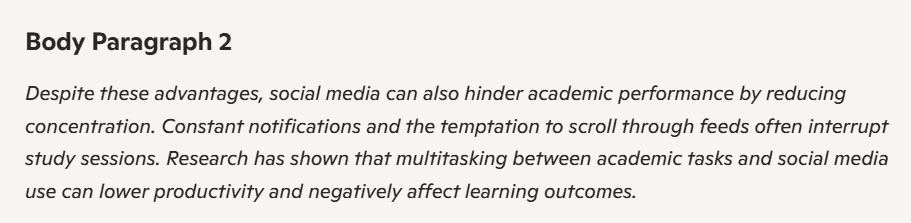
But make sure that this section builds logically on the first point rather than repeating it.
Body Paragraph 3
This is the section where you will address a counterargument or include an additional perspective.
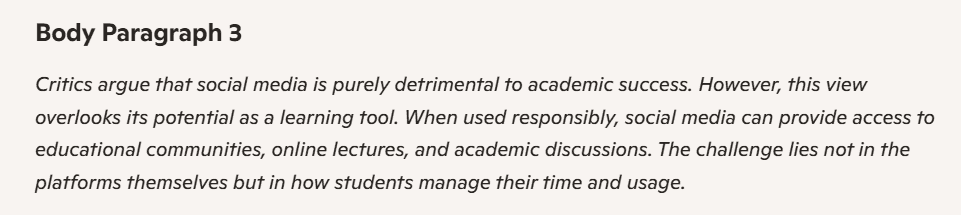
But how?
Well, by refuting or supporting opposing views, you will demonstrate critical thinking and strengthen your essay’s credibility here.
Conclusion
And finally, the last (concluding) section will tie everything together. At this stage, your goal is to close the discussion in a clear and structured way rather than introduce anything new.
So, here, you will revisit your main argument and reinforce the overall direction of your essay. To do this, you can:
- Restate the thesis statement in new wording
- Summarize your key arguments
- Provide a final insight or implication related to the topic
But remember that a strong conclusion doesn’t repeat the information; it reinforces the essay’s argument. And here is an example that highlights the perfect example of such a concluding section:
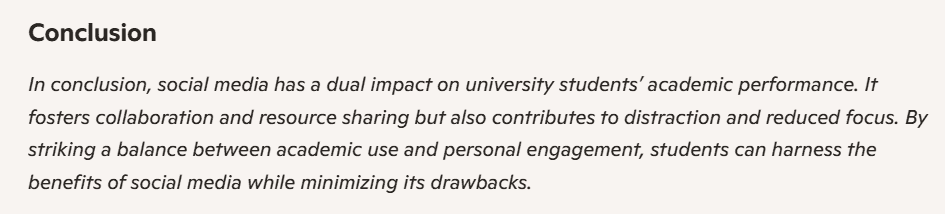
Step 5: Maintain a Logical Flow
While writing the content for the body paragraphs, you will have to maintain a logical flow between your ideas. And for that, you can use transitional words or phrases, such as the following:
- As a result
- However
- In addition
- On the other hand
- Therefore
However, make sure that the addition of your transitions feels natural, not robotic. That’s the only way your transitions will fulfill the intended purpose of making your essay feel structured.
For better understanding, take a look at the following example:
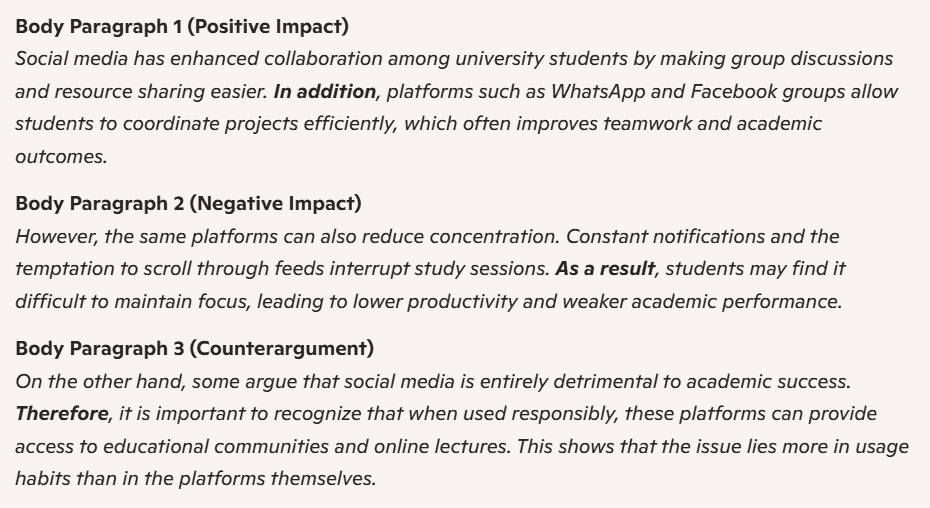
Step 6: Edit and Refine — The Stage Where Grades Are Won
Most students think that their job is done after the writing phase. But that’s where they’re wrong; it is also essential to edit and refine the content of an essay. Why?
Well, that’s because editing improves the quality more than writing itself. So, in this step, check for the following things:
- Grammar errors
- Logical gaps
- Different types of plagiarism
- Weak arguments
- Unclear sentences
And to make sure that you successfully locate all these issues, read aloud the whole material. If you can’t do this yourself, you can use the ‘Read Aloud’ feature of your word processing software or ask a trusted third party.
But the issue is, you can’t identify plagiarism by reading your essay out loud. For that, you can run your content through a plagiarism checker, which can help highlight any accidental or hidden matches with existing academic pieces.
So, if your essay’s content has any underlying traces of plagiarism, make sure to rework them before finalizing.
Some Common Essay Writing Mistakes
Even if you follow the steps discussed above, certain mistakes can still weaken your essay. So, the points below highlight some of the most common pitfalls that significantly reduce academic performance:
Ignoring Prompt Requirements
Straying away from the essay’s question or scope means you are not addressing what is actually being asked, which leads to losing marks.
Mixing Multiple Ideas in One Paragraph
Combining several ideas in a single paragraph makes your writing confusing and prevents proper development of each point.
No Clear Thesis
Without a clear thesis statement, your essay lacks direction and fails to communicate the central argument to the reader.
No Proofreading
Skipping proofreading leaves grammar errors, logical gaps, and typos unchecked, which lowers the overall quality of your work.
Overly Complex Sentences
Using complicated or unnecessarily long sentences makes your essay harder to read and reduces the overall clarity.
Using Weak or Missing Evidence
Arguments without credible support appear unconvincing and undermine the authority of your essay.
Answering Your Queries With Some Common FAQs
How can I improve my essay writing skills quickly?
To quickly improve your essay writing skills, you need to practice structured writing regularly. Besides, you should also review sample essays and focus on improving clarity, grammar, and logical flow rather than vocabulary’s complexity.
How do I choose a good essay topic?
A good essay topic is researchable, specific, and aligned with your assignment requirements. So, avoid overly broad topics.
What is the difference between an essay and a report?
An essay focuses on analysis and argument, while a report concentrates on presenting structured factual information in sections.
Why do essays lose marks even if the content is correct?
Most essays lose marks due to lack of logical flow, poor structure, or weak thesis clarity—not necessarily incorrect information.
Final Thoughts
To sum up, essay writing is not about writing more; it is about writing with clarity, intent, and structure. And once you understand how evidence, structure, and thesis work together, essay writing becomes a predictable system rather than a stressful task. But remember, in a strong essay, every paragraph must serve the thesis statement.

WordlyCove is a peaceful space where words, writing, and knowledge come together, an ideal platform for writers and learners.
