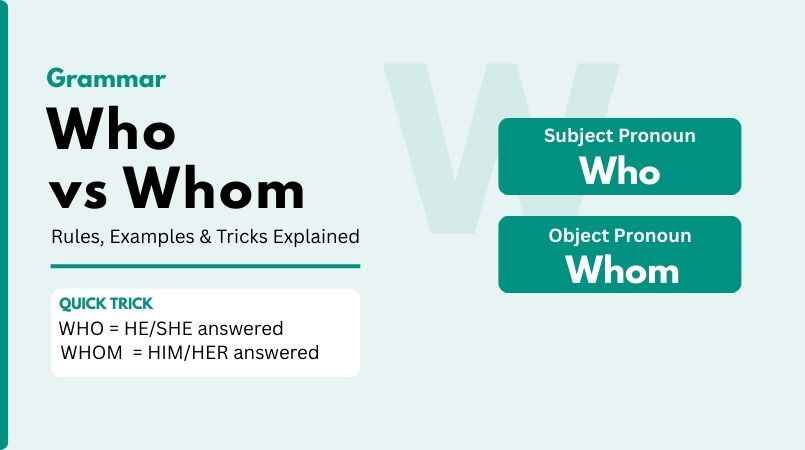
Want to sound confident in English? The best way to go about it is to master small grammar differences that others usually avoid. One of them is the usage of who vs whom.
When deciding between them, many people rely on instincts—they think that using ‘whom’ feels awkward. However, that’s not the best approach.
You can easily master the rule on using ‘whom’ and ‘who’ by understanding the work of the object and subject in both contexts. And that’s where this blog post will help you, as it simplifies the exact difference.
Not only that, but here, you will also find some practical memory tricks to help you handle even the trickiest sentences with confidence. So, let’s begin!
Who vs Whom — Key Difference Explained
Who and whom might seem interchangeable at first, but in reality, that’s not the case.
As a matter of fact, both these interrogative pronouns belong to different cases of grammar. For instance,
Whom = object pronoun
Who = subject pronoun
But what do the terms ‘object’ and ‘subject’ actually mean here?
Well, to put it simply, the subject refers to the doer of the action, and the object is the receiver of the action in a sentence. The following example better clarifies the difference between the two:
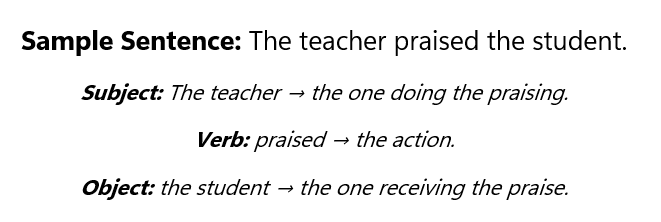
Anyway, the confusion between who and whom comes from the same system that gave us:
He / Him
I / Me
She / Her
They / Them
Now, just like you can’t say something like this: ‘Me wrote this content.’ In the same way, you shouldn’t confuse whom (the objective form) with who (the subject form).
But why does this difference still matter?
Well, English may have gotten informal nowadays, but the formal sectors, such as academic papers, professional emails, and legal writing, still expect the proper usage of everything. Therefore, if you use who and whom properly, it will reflect your credibility and strong command of grammar.
When to Use Who
As we’ve mentioned briefly, ‘who’ is a subject-related interrogative pronoun. Therefore, when the ‘pronoun is performing the action’ in a sentence, you should use ‘who.’
For instance, if you can replace ‘who’ with ‘he,’ ‘she,’ or ‘they’ in a sentence, its usage is correct. See the following table to better clarify this point:
| Sentence | Why It’s ‘Who’ |
| Do you know who called earlier? | ‘Who’ is the subject of ‘called.’ |
| She is the one who solved the problem. | ‘Who’ is the subject of ‘solved.’ |
| Who is leading the project? | ‘Who’ performs the action (is leading). |
| Who wants to volunteer? | ‘Who’ is doing the wanting. |
An Important Clause Trap
Imagine a situation where you’re dealing with a sentence like this:
Who do you think will win?
Now, at first, you might think that ‘who’ is the ‘object’ of ‘do you think.’ Right? But in reality, that’s not true. How?
Well, let’s understand this step-by-step. First, let’s transform the above-mentioned question into a simple form.
You think he will win
Now, in this non-question form,
Subject = he
Verb = will win
So, ‘he’ is the one doing the winning, making it the ‘subject.’ Now, simply replace it with ‘who’ and you’ll get: ‘You think who will win.’ And hence, ‘who’ turns out to be the ‘subject’ of ‘will win’—it’s that simple!
However, many writers, even some experienced ones, when dealing with such situations, often end up using ‘whom’ instead of ‘who.’ So, if you want to avoid this mistake, you should always identify the verb that the pronoun belongs to.
When to Use Whom
As we’ve already discussed, ‘whom’ is an object-related interrogative pronoun. So, you can use it when the ‘pronoun functions as an object.’
Now, the object can be of a:
- Preposition
OR
- Verb
However, in simple terms, you just need to remember one rule:
If you can replace the pronoun with ‘her,’ ‘him,’ or ‘them,’ you can then use ‘whom.’
However, let’s elaborate on its usage more by discussing the aforementioned two forms of object:
Object of a Verb
| Sentence | Why It’s ‘Whom’ |
| The candidate whom we selected has accepted. | ‘We selected him.’ |
| Whom did they appoint as manager? | They appointed ‘him.’ |
| Whom did you invite? | You invited ‘him’ → object. |
Object of a Preposition
Prepositions are terms, such as ‘about,’ ‘among,’ ‘by,’ ‘for,’ ‘from,’ ‘to,’ ‘with,’ etc.
| Sentence | Why It’s ‘Whom’ |
| From whom did you receive the email? | Received from ‘him.’ |
| To whom should I respond? | Respond to ‘him.’ |
| With whom are you traveling? | Traveling with ‘him.’ |
Clever Preposition Trick
Sometimes, you may have heard people saying or writing like this:
Who are you speaking with?—informal setups
With whom are you speaking?—formal setups
Both these are acceptable forms. However, from a technical viewpoint, ‘whom’ is correct because it provides precision, which is essential there. The ‘who’ variation is correct from a conversational or modern English standpoint.
How to Remember Who vs Whom & Use Them Correctly
If you’ve followed the above discussion, you may have understood when you need to use ‘who’ and ‘whom’ respectively. Right? But to truly remember the difference and make sure you always use the correct variation, follow these reliable strategies:
1) The He/Him Rule (Most Reliable)
The best and simplest way to use the correct variation out of ‘who’ and ‘whom’ is to go with the ‘he/him,’ ‘she/her,’ and ‘they/them’ substitution.
For instance, if you can replace the pronoun with ‘he,’ ‘she,’ or ‘they’ variations, then ‘who’ is grammatically correct.
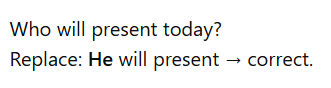
However, if the ‘him,’ ‘her,’ or ‘them’ variations are grammatically correct, then ‘whom’ is the appropriate fit.
2) Identify the Real Verb
There are situations where the real action is hidden somewhere in the sentence. In such a situation, you can use the breakdown technique.
For instance, let’s say that this is a sentence: ‘Whom do you believe is responsible?’
Now, first convert it into the non-question form: ‘You believe he is responsible.’
In this version, ‘he’ is the ‘subject’ and ‘is responsible’ is the ‘verb’ portion. And since ‘he’ is the responsible, by replacing it with an appropriate pronoun variation, we get ‘who’ as the answer. So, the correct variation is as follows:
Who do you believe is responsible?
3) Look for Prepositions
There are times when the pronoun comes directly after a preposition (like by, for, to, with). So, in such a situation, ‘whom’ is usually the most appropriate choice for formal writing setups.
Here are a few examples of such variations:
By whom—By whom was the book written?
For whom—For whom are you buying this gift?
To whom—To whom should I address the letter?
With whom—With whom did you go to the party?
4) Know When It’s Acceptable to Use ‘Who’
‘Whom’ is often considered a stiff variation in everyday usage. Therefore, if you’re dealing with such a scenario or informal setup, always use ‘who.’
Who did you talk to?
However, for formal writing setups, it is essential to respect the traditions. So, in such situations, you can use ‘whom’ where applicable:
To whom it may concern
Examples Table for the Usage of Who vs Whom
Now, everything you’ve learned from above, you can put to use here:
| Sentence | Correct Variation | Why Is This Correct? |
| I don’t know ___ will replace her. | Who | Subject of ‘will replace.’ |
| The author ___ wrote this book is famous. | Who | Subject of ‘wrote.’ |
| The employee ___ we promoted thanked us. | Whom | Object of ‘promoted.’ |
| The manager, ___ everyone trusts, resigned. | Whom | Object of ‘trusts.’ |
| ___ did you call last night? | Whom | Object of ‘call.’ |
| ___ do you think deserves the award? | Who | ‘He deserves’ → subject. |
| ___ is at the door? | Who | Subject of ‘is.’ |
Answering Your Confusion About Who and Whom — FAQs
1) Can I just avoid using ‘whom’?
Yes, you can. In fact, many writers simply rephrase the ‘whom’ variation (Whom did you consult?) like this: ‘Who did you consult?’ or ‘Who did you talk to?’ However, if you’re dealing with a formal writing setup, using ‘whom’ is always the most grammatically correct form.
2) Is ‘whom’ disappearing from English?
Yes, partially, as it is becoming less common in casual or everyday contexts. However, academic work, formal setups, and professional communication still use the ‘whom’ variations.
3) Is it wrong to say ‘Who did you give to’?
It depends on the context. For instance, this variation is acceptable in casual or everyday contexts. However, the correct grammatical form in formal setups is ‘To whom did you give it?’
4) What about whomever vs. whoever?
The same rule applies here as well. Whoever → subject and whomever → object.
5) Why does ‘whom’ sound awkward?
Using ‘whom’ feels awkward in most cases because the English language nowadays doesn’t mark cases in most nouns. And since most pronouns don’t change forms, that’s exactly why ‘whom’ feels old-fashioned.
Concluding Remarks
When it comes to mastering the usage of who vs whom, you don’t need to memorize the complicated grammar rules. Instead, you should understand one major difference—subject vs. object. If you can spot these and apply the aforementioned strategies successfully, this confusion will quickly fade away.

WordlyCove is a peaceful space where words, writing, and knowledge come together, an ideal platform for writers and learners.
