If you’ve ever stood in front of a classroom with a blank notebook and there are just about five minutes until your name gets called, you already know the real problem isn’t public speaking. It’s picking what to talk about.
The reality is:
If students have been assigned a topic they actually have something to say about, half the nervousness will disappear on its own.
And that’s what this blog post is for.
Here, you’ll find more than 200 English speech topics for students, sorted by age group and theme. So, a seven-year-old picking their first assembly topic and a final-year university student prepping for a seminar can both find something that fits.
Besides the list, there is also a short guide on choosing a topic, structuring it, and saying it out loud without falling apart halfway through.
So, let’s dig in!
Quick Summary, if You’re Skimming
Pick a topic you already know something about and care about a little. That’s because research-from-scratch topics tend to sound flat out loud.
Match your word count to your time: roughly 130–150 words per spoken minute.
One idea, backed by one example, beats five ideas crammed into the same speech.
Memorize your opening and closing lines. Let the middle stay loose, so one forgotten word doesn’t stop you cold.
The Real Reason Teachers Assign Speech Topics
Before you scroll further, it helps to know why this kind of assignment keeps showing up, year after year.
Well, simply put, a speech isn’t really graded on how impressive the topic sounds; it is testing something else:
Whether you can organize a thought, hold a room’s attention for a few minutes, and say something in your own words instead of repeating what you found online.
That is why copying a speech word for word almost always backfires—it’s not because of the honesty problem, which matters too. It’s due to the fact that copied speech has none of your own thinking in it, and an audience can feel that within the first few lines.
So, whether a teacher hands you a topic or lets you pick your own, treat the assignment as a practice for learning how to think quickly, instead of a chore to rush through and finish.
Why the Topic Matters More Than the Grammar
Most students worry about fancy vocabulary, perfect grammar, and sounding ‘impressive.’ But none of that saves a speech that is based on a topic the speaker doesn’t care about.
The reality is,
An audience can tell within ten seconds whether you’re speaking from something real or reciting something you copied off a website at midnight.
So, before we get to the 200+ English speech topics for students, here are 3 quick filters that are worth applying to any topic you’re considering, regardless of whether it comes from this blog post or somewhere else:
1) Can You Explain It in One Sentence?
If your main idea needs three sentences to state, it’s too big for the time you’ve been given.
2) Do You Already Know Something About It?
You shouldn’t have to start from zero research. A topic you’ve lived with, even a little bit, beats the one you’re learning for the first time an hour before class.
3) Is There a Story or Example Attached to It?
Facts alone are forgettable. That’s because the speech people remember almost always has one small moment:
Something that happened, something you noticed, something you tried and got wrong.
So, just keep these 3 filters in mind as you scroll, and your English speech topic selection will be spot on.
How Long Should a Student’s Speech Be?
The answer to this question changes by assignment and grade, but here’s a rough guide that teachers commonly use:
| Grade Level | Typical Length | Approx. Word Count |
| Elementary (Grades 1–5) | 1–2 minutes | 100–250 words |
| Middle school (Grades 6–8) | 2–3 minutes | 250–400 words |
| High school (Grades 9–12) | 3–5 minutes | 400–650 words |
| College / University | 5–7 minutes | 650–900 words |
Remember that these aren’t strict rules because a competitive formal debate will have its own time limit. But they’re close enough for most classroom speeches. For instance, speaking pace runs around 130–150 words per minute for someone talking clearly. So, if you’re writing a five-minute speech and you’re at 300 words, you’ve got room to add another example.
One more note before the list:
Not every set of English speech topics for students needs to sound ‘academic’ to work.
That’s because some of the strongest classroom speeches come from a habit, a memory, a small opinion, and the simplest prompts, delivered with real conviction.
A Simple Structure That Works for Any Topic
You don’t need a different format for every speech. One shape, used again and again, will carry almost any topic on this list:
1) Open With Something Other Than “Today I Will Talk About…”
This could be a question, a short scene, or an odd fact, as they all work better than a flat announcement.
2) State Your One Main Idea
Just one will be enough because speeches with five points often blur together, but those with one point stick.
3) Back It Up
Use a personal story, a real-world example—something the audience can picture.
4) Tell Them What to Do With It
Tell them what they should remember, think, or try differently after hearing you.
5) End on Your Best Line, Then Stop
Don’t drift into “…so yeah, that’s basically it.” Land the ending and sit down.
Not Every Speech Topic Works the Same Way
Before you pick from the list below, it helps to know that speech topics usually fall into 3 types. And you should know which one you’re working with, as this understanding will help structure the speech properly.
1) Factual Topics
These ask you to explain something as it is, mainly through examples and information. And you don’t necessarily need to argue a side.
For instance, “Why plants need water and sunlight” is a factual topic because, in this, you will be informing the audience, instead of convincing them.
2) Policy Topics
These ask you to take a stance on a rule or a system and argue ‘whether it should change.’
For instance, “Should schools ban phones during class hours?” is a policy topic because in this, you’re expected to weigh both sides and eventually land somewhere.
3) Value Topics
These topics are about right and wrong, rather than the rules.
For instance, “Is honesty always the right choice?” is a value topic because there is no policy to argue for here; this example topic just represents a belief that you’re asking the audience to sit with.
Key Note: Now, most of the topics on the list can be approached from more than one of these angles. For instance, “Why failing at something isn’t the end of the world” can work both as a factual story about what actually happened or as a value argument about why failure matters more than we think. So, pick whichever angle you can speak on most naturally.
30 English Speech Topics for Elementary Students (Grades 1–5)
Young speakers do best with topics tied to things they already know.
This could be something related to animals, everyday habits, home, or school. So, keep sentences short and let them use their own words.
- A pet I have or wish I had
- A time I felt proud of myself
- A time I helped someone
- My best friend
- My family’s favorite tradition
- My favorite animal and why I like it
- My favorite cartoon character
- My favorite book and its lesson
- My favorite food and how it’s made
- My favorite game to play with friends
- My favorite season of the year
- My favorite subject in school
- My favorite superhero and what makes them super
- The best day of my summer vacation
- The best gift I ever received
- The chore I dislike the most (and why)
- The place I most want to visit
- What I do after school
- What I want to be when I grow up
- What I would do with one extra hour every day
- What makes a good friend
- Why brushing your teeth matters
- Why I like rainy days
- Why I love my school
- Why plants need water and sunlight
- Why sharing is important
- Why sleep helps you grow
- Why teamwork matters, even in games
- Why we should say ‘please’ and ‘thank you’
- Why we shouldn’t litter
40 English Speech Topics for Students That Belong to Middle School (Grades 6–8)
At this stage, students can hold a slightly bigger idea and add a small opinion of their own. So, the topics in this category work well for class presentations, English period activities, and short assemblies.
Character and Growth
- How I handle being nervous before something big
- The best advice an adult ever gave me
- The bravest thing I’ve ever done
- What patience has taught me
- Why comparing yourself to others rarely helps
- Why failing at something isn’t the end of the world
- Why I think kindness is a decision, not a feeling
- Why saying sorry is harder than it sounds
Community and Environment
- Small habits that help the planet
- The problem with food waste at school
- What clean air actually means for our health
- What my neighborhood needs more of
- Why every classroom should have a plant
- Why I think plastic bags should be banned
- Why my school should have a recycling program
- Why saving water starts with small choices
Everyday Life and Habits
- A mistake that taught me something
- My favorite way to spend a weekend
- My morning routine and how I’d improve it
- The habit I’m proudest of building
- Why breakfast affects how you feel all day
- Why handwriting still matters in a digital world
- Why I think homework should (or shouldn’t) change
- Why I think uniforms help or hurt school life
Learning and School
- Should students have a say in school rules?
- The best way I’ve found to study for tests
- The subject I wish schools taught
- Why group projects are harder than they sound
- What makes a teacher unforgettable
- Why exams don’t show the whole picture
- Why I think class discussions matter more than lectures
- Why reading for fun is different from reading for class
Media and Technology
- How much screen time is too much?
- Is gaming a waste of time or a useful skill?
- Is social media good or bad for people my age?
- The risk of believing everything you see online
- What makes a video go viral, and does it matter?
- Why I think AI tools in class need clear rules
- Why I try to notice how I feel after scrolling
- Why passwords and online privacy matter more than we think
50 Best Topics for Speech for High School Students (Grades 9–12)
High schoolers can take on topics with more nuance.
Now, this could be something related to careers, ethics, society, and even bigger questions like ‘what do I actually think?’ These suit college-prep seminars and debates.
Abstract and Ethics Ideas
- Is honesty always the right choice?
- What does true freedom mean?
- Can a person be too ambitious?
- Is silence sometimes a form of agreement?
- Why do we fear failure more than we fear regret?
- Is change always progress?
- What separates confidence from arrogance?
- Should rules ever be broken for a good reason?
- Is empathy something you’re born with, or something you build?
- What does it mean to live with integrity?
Career and Future Planning
- Is a college degree still worth the cost?
- Is entrepreneurship a realistic path for students?
- Is following your passion realistic advice?
- Should gap years be encouraged more?
- Should students choose a career path before college?
- What does financial literacy mean for someone my age?
- What I actually want from my career, versus what’s expected of me
- Why internships teach what classrooms can’t
- Why networking starts earlier than people think
- Why soft skills might matter more than grades
Current and Society Issues
- Does social media do more harm than good?
- Is a four-day school week a good idea?
- Is it cancel-culture accountability or overreach?
- Is competition healthy or harmful among students?
- Should schools ban phones during class hours?
- Should students be allowed to grade their teachers?
- Should voting age be lowered?
- Why mental health deserves a place in the curriculum
- Why misinformation spreads faster than facts
- Why representation in media matters
Environment and Global Issues
- Is individual action enough, or do we need bigger change?
- Is recycling actually working?
- Should plastic packaging be banned outright?
- The true cost of fast fashion
- What one policy change would help the environment most?
- What responsible consumption actually looks like
- Why biodiversity loss doesn’t get enough attention
- Why clean energy adoption is moving too slowly
- Why climate change is a young person’s problem too
- Why water scarcity will define this century
Technology and the Future
- Are algorithms deciding too much of what we see and think?
- Can technology fix the problems it creates?
- Is space exploration worth the cost?
- Is virtual reality the future of learning?
- Should schools teach coding as a core subject?
- Should self-driving cars be trusted on public roads?
- Why cybersecurity awareness should start earlier
- Why data privacy should matter to every teenager
- Will artificial intelligence take away more jobs than it creates?
- What happens when AI writes better than we do?
50 English Speech Topics for Students That Belong to Colleges and Universities
At this level, speeches often double as arguments for a debate club, a placement group discussion, or a seminar. So, the topics here should reward research, a clear stance, and confident delivery.
AI, Ethics, and Technology
- Is automation a threat to entry-level jobs specifically?
- Is data the most valuable resource of this century?
- Is digital surveillance a fair trade for convenience?
- Is the ‘attention economy’ doing us more harm than good?
- Should AI-generated work be allowed in academic settings?
- Should social media platforms be regulated more strictly?
- Should there be an age limit for social media use?
- What ethical limits should AI research have?
- Why algorithmic bias is harder to fix than it sounds
- Why open-source technology matters for innovation
Career and Workplace
- Is remote work better for productivity or worse?
- Is burnout a personal problem or a systemic one?
- Is job-hopping a smart strategy or a red flag?
- Should internships always be paid?
- Should companies mandate a return to the office?
- Should salaries be transparent across a company?
- What does work-life balance actually require?
- What makes a workplace genuinely inclusive?
- Why communication skills decide careers more than technical skills do
- Why mentorship matters more than most students realize
Education and Higher Learning
- Is a gap year before university a good idea?
- Is online education as effective as in-person learning?
- Is peer learning underrated?
- Is standardized testing a fair way to measure ability?
- Should grades be replaced with detailed feedback?
- Should university be free for everyone?
- Should universities do more to prepare students for real jobs?
- What’s lost when lectures move entirely online?
- Why critical thinking is harder to teach than facts
- Why some of the best learning happens outside a classroom
Global, Politics, and Society Affairs
- Is free speech absolute, or does it need limits?
- Is globalization narrowing or widening inequality?
- Is public trust in institutions recoverable?
- Should countries prioritize national interest or global cooperation?
- Should immigration policy be judged by economics or ethics first?
- Should voting be made mandatory?
- What does true equality of opportunity look like?
- What responsibility does the developed world have toward the developing one?
- Why civic engagement matters beyond election years
- Why local politics deserves as much attention as national politics
Personal Development and Philosophy
- Can you build confidence, or is it mostly personality?
- Is ambition compatible with contentment?
- Is comparison ever useful?
- Is multitasking a myth?
- What does it mean to know yourself?
- What does success mean once grades stop being the measure?
- What’s the real difference between busy and productive?
- What would you attempt if you knew you couldn’t fail?
- Why discipline outperforms motivation over time
- Why some failures matter more than others
30 Unique English Speech Topics for Students Who Want to Stand Out
If you’ve scrolled this far, you’ve probably noticed the usual suspects:
Career advice, environment, and technology.
These unique speech topics for students take a different angle. They’re slightly odd, but still workable inside a normal classroom speech. In fact, they tend to hold an audience’s attention precisely because nobody expects them.
- The best compliment you never said out loud
- The best thing you ever did out of spontaneity
- The case for being bored on purpose
- The habit you’re quietly proud of
- The last thing that genuinely surprised you
- The last time you changed your mind about something—what happened?
- The last thing you Googled at 2 a.m.
- The object in your room that means more than it should
- The strange comfort of rewatching the same show
- The unspoken rules of group projects
- The unwritten rules of a school cafeteria
- What a good apology actually sounds like
- What a lucky mistake taught you
- What a stranger’s kindness once meant to you
- What board games teach that textbooks don’t
- What one habit, dropped tomorrow, would change your life the most
- What silence says that words can’t
- What would happen if everyone told the truth for one day?
- What would you tell your younger self, honestly?
- What your group chat says about your generation
- What your playlist reveals about a hard week
- What your search history says about you
- Why ‘small talk’ is a bigger skill than people admit
- Why ‘good enough’ sometimes beats ‘perfect’
- Why “just Google it” is changing how we think
- Why every generation thinks the next one has it easier
- Why nostalgia is more powerful than logic
- Why some songs feel like time travel
- Why some rules exist even after their reason is forgotten
- Why some rumors spread faster than the truth ever could
- Why the ‘main character’ mindset online is both helpful and harmful
- Why waiting rooms are underrated thinking spaces
One Sample of a Fully Written English Speech
Reading a finished speech usually teaches more than another rule ever could. So, here is a short one, written the way it would actually be spoken out loud, not the way it would be written in an essay.
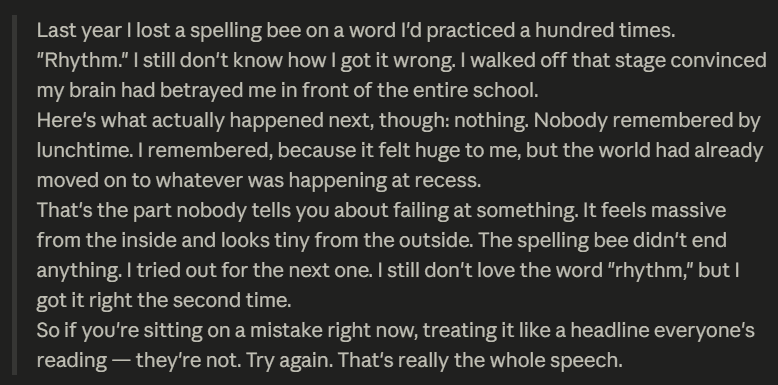
Now, that’s about 170 words, short, personal, and built entirely around one small moment. And as you may have observed, our example doesn’t try to cover everything about failure; it picks one memory and stays there. And that’s really the whole formula.
Common Mistakes That Sink an Otherwise Good Speech
Even the strongest English speech topic for students can still fall flat if they are delivered badly. So, here are a few patterns that often show up in badly delivered speeches:
1) Opening With “Today I Am Going to Talk About…”
It’s the least interesting sentence available to you. So, greet the room, then hook the audience. Don’t announce the topic before you’ve earned their attention.
2) Trying to Fit Five Ideas Into a Two-Minute Slot
Pick the one point you actually believe and cut the rest, even if it hurts.
3) Writing Like an Essay Instead of Talking Like a Person
Long, formal sentences that look fine on paper often sound stiff out loud. So, read your draft aloud and rewrite anywhere you stumble.
4) Memorizing Every Single Word
One forgotten word can freeze the whole thing. Therefore, memorize the shape of the speech—opening, point, story, ending—and let the middle come out slightly differently each time.
5) Skipping Rehearsal Entirely
Reading a speech in your head and saying it out loud in front of people are two different skills. So, practice the second one.
A Few Delivery Habits That Make Any Topic Land Better
Picking the right topic gets you halfway there. The other half is what you do with your voice, your face, and the room while you’re actually saying it. So, these are some delivery habits that can help you land any topic better:
1) Choose Topics the Audience Can Picture
Some topics vanish the moment you stop talking. Others stick because the audience can actually see a moment, a place, or a specific choice you may have made while speaking on it.
So, whenever it’s possible, lean toward the second kind.
2) Make Eye Contact With More Than One Person
Staring at your notes the entire time is one of the fastest ways to lose an audience. Therefore, you should pick two or three spots around the room and rotate between them.
3) Match Your Vocabulary to the Room
A speech written for your classmates and the one written for a spelling-bee judge shouldn’t sound the same. Right?
Therefore, you should use words that your audience already knows, and save the impressive ones when you’re writing an essay.
4) Let a Little Humor In, if It Fits
You don’t need to be funny to give a good speech, but one well-placed light line can reset a room’s attention.
However, don’t force it if the topic doesn’t call for it. And more importantly, you should never make the humor about someone specific in the room, as it can do more harm than good.
5) Slow Down for the Words That Matter
Most nervous speakers speed up exactly when they should slow down. So, remember:
If a line matters, say it a little slower than feels natural.
It won’t sound slow to the audience; it will make you sound confident.
6) Watch Your Body Language, Not Just Your Words
You don’t need big gestures, but at the same time, you shouldn’t fight your own posture while you talk.
So, remember that standing stiff with your arms crossed says something different than standing loose with your hands free.
Frequently Asked Questions
Are these speech topics suitable for candidates at both school and college levels?
Yes, though the depth expected changes. For instance, a middle schooler and a university student could both speak on ‘why failing at something isn’t the end of the world.’ However, the college version would likely bring in more analysis and a wider example, while the middle-school version stays close to one personal story.
How do I pick a topic for speech quickly when I’m short on time?
Scan the above-provided English speech topics for students list for a category that matches your grade and your assignment length. Then, ask whether you could talk about it for thirty seconds right now, without notes. If yes, then it’s usable. But if you would need to research it from scratch, then skip it and pick another.
How many words should a two- to three-minute speech be?
Roughly 250 to 400 words, based on an average speaking pace of about 130 to 150 words per minute. So, if you tend to speed up when you’re nervous, which most speakers do, then write toward the lower end.
What are some good English speech topics for students?
Good speech topics for students are usually the ones that the speaker already knows something about and has a small opinion on—a change they would make at school, a habit they’ve built, or a question they genuinely wonder about.
What is the single best tip for choosing among the list of the best English speech topics for students?
Pick the one you would still want to talk about even if nobody was grading you. Because that’s usually the one where the nerves show the least, and the delivery sounds the most like you.
What makes a topic ‘unique’ rather than just different?
Usually, a unique speech topic for students is about finding an ordinary subject and asking a question about it that most people haven’t thought through out loud. For instance, something like ‘Why waiting rooms are underrated thinking spaces’ works because it’s small, specific, and honest, not because it’s exotic.
So, Before You Pick One, Hear Us Out
There are 200-plus English speech topics for students above, sorted so a first grader and a graduating senior can both find something worth saying. But a list only gets you halfway. For instance, the topic sets up the speech, but the practice is what actually makes it land.
So, read your choice out loud tonight, even just once, even just to an empty room. In this way, you’ll notice within thirty seconds which sentences sound natural and which ones you would never actually say. Then, fix those and say it again tomorrow. And by the time you’re standing up in front of the class, it won’t feel like a memorized speech anymore; it will just sound like you, talking about something you happen to know.

WordlyCove is a peaceful space where words, writing, and knowledge come together, an ideal platform for writers and learners.
