You read a paragraph, like it, and then try to describe it in your own words. However, your version looks quite similar to the original one, or it conveys a whole different idea.
Has this ever happened to you? If so, then you haven’t quite mastered the art of paraphrasing.
Every professional, student, or writer experiences the same problem at some point in their journey. And for them, we’ve created this blog post where we’re going to explain the concept of paraphrasing with the help of examples.
So, without wasting any time, let’s get started!
What Is Paraphrasing in Simple Terms?
Paraphrasing is a technical term that refers to the process of restating someone else’s ideas in your own words while preserving the original sense. That idea could be a:
- Academic passage (dissertations, essays, research papers)
- Digital content (blogs, social media posts, web pages)
- Journalistic write-up (editorials, news articles, reports)
- Literary or creative work (novels, poems, stories)
- Spoken information (conversations, lectures, interviews)
So, this technique is quite common in academic, blogging, journalistic, professional, and research setups. That’s simply because it saves from copying the information as-is.
Instead, you need to change the wording, sentence structure, and sometimes, the overall tone, to successfully paraphrase something.
So, in a nutshell, paraphrasing refers to the idea of saying the same thing differently. Got it? If so, let’s move forward!
How Paraphrasing Differs From Quotation?
People need to paraphrase or quote the information whenever they have to use someone else’s ideas. Right?
Therefore, they often get confused between these two concepts. But these two are completely different techniques. For instance,
- Paraphrasing involves completely rewriting an idea without changing the intended meaning.
- Quoting means using the exact content word-for-word and placing it inside double quotes (“ “).
So, the main difference between them lies in the wording and presentation of the language. However, the successful implementation of both these techniques requires citing the original source, especially in academic contexts.
Here is an example to clarify this difference better:
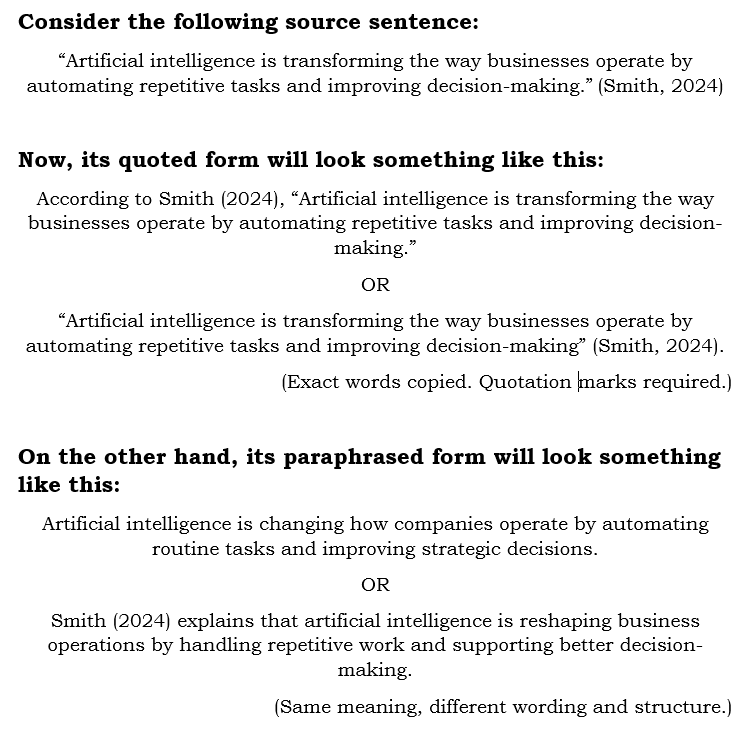
Note: In this example, we’ve followed the APA citation style.
As you can see, the wording looks quite different in the paraphrased form. So, it is a perfectly restated variation.
Purpose of Paraphrasing
Now, you might be wondering: Why do people paraphrase something?
Well, they do so because it helps:
- Avoid plagiarism by rewording the text and citing the source. But if you don’t know how close is ‘too close,’ read our guide on the detailed difference between paraphrasing and plagiarism.
- Change the writing style and tone to a certain type of audience.
- Showcase an understanding of the subject matter.
- Simplify complex information and make it accessible to a broader audience.
- Improve the flow and readability of a write-up.
- Transform lengthy explanations into shorter ones and vice versa.
And all of this is possible by not only swapping words but also reshaping the entire message while maintaining the intended meaning.
Simple Paraphrasing Examples
Now that the theoretical aspect is clear, let’s sign off by sharing the various examples of paraphrasing from different contexts:
Example 1 – Academic Context
Source Text: Regular exercise reduces the risk of chronic diseases such as diabetes and heart conditions.
Paraphrased Form: Engaging in consistent physical activity lowers the chances of developing long-term illnesses like diabetes and heart disease.
Example 2 – Business Context
Original Source: Customer satisfaction plays a crucial role in building long-term brand loyalty.
Paraphrased Version: Keeping customers happy is essential for developing lasting loyalty to a brand.
Example 3 – Technical to Simple
Source Text: Photosynthesis is the biochemical process through which plants convert sunlight into energy.
Paraphrased Form: Photosynthesis is the process plants use to turn sunlight into energy.
Example 4 – Condensed Form
Original Source: Social media platforms have significantly influenced communication patterns by enabling instant global interaction.
Paraphrased (Shorter) Version: Social media has changed communication by allowing instant worldwide interaction.
FAQs
Can changing a few words count as paraphrasing?
No, that’s rewording. To paraphrase successfully, you need to restructure the sentences and actually reshape the idea while preserving the original meaning.
Do I need to cite a source when paraphrasing?
Yes, because restating someone else’s information doesn’t make you its original owner.
How can I tell if my paraphrasing is too similar to the original?
If the key phrases and sentence structures look the same, your paraphrased form is too similar to the original version. You can also consider using the best plagiarism checkers to figure out if you have paraphrased text correctly or it still appears plagiarized.
Is paraphrasing the same as summarizing?
No. Summarizing is a part of paraphrasing because sometimes, when you paraphrase, you also condense the information.
Is paraphrasing useful for SEO content?
Yes. Paraphrasing helps avoid duplicate content issues and improves readability. And these things are crucial from the on-page aspect of SEO.
Why is paraphrasing important for students?
Students should learn to paraphrase because it helps them showcase their understanding of a topic, change the writing style, simplify concepts, and improve readability.
What is the biggest mistake people make when paraphrasing?
The major mistake in paraphrasing is patchwriting, where people only swap a few words with their synonyms, but the structuring of the sentences remains unchanged.
Can AI tools help with paraphrasing?
Yes, AI paraphrasing tools can help with paraphrasing; but you still need human judgment to analyze whether the output is correct or not.
Wrapping Up
All in all, paraphrasing involves more than just rewording. It first requires an understanding of the source before re-expressing the information in an accurate, clear, and new way. So, if you do it correctly, it can help you avoid plagiarism, demonstrate your understanding, and improve readability. But don’t forget to properly cite the sources. Otherwise, your paraphrased information will still be considered plagiarism.
Anyway, to master it, make sure to concentrate on comprehension, sentence restructuring, and meaning preservation!

WordlyCove is a peaceful space where words, writing, and knowledge come together, an ideal platform for writers and learners.
